
RESOLVING THE LEDGER
RESOLVING THE LEDGER
Only one outlet has reported this event so far — you're reading it below, credited to its source. AIPROPX is tracking the web for more coverage; as additional outlets confirm it, this becomes a full multi-source story automatically.
By AIPROPX Editorial Desk · Published · Updated
One outlet is reporting this so far. AIPROPX is tracking it and will gather every additional source as it develops — the full multi-source comparison appears automatically once a second outlet confirms it.
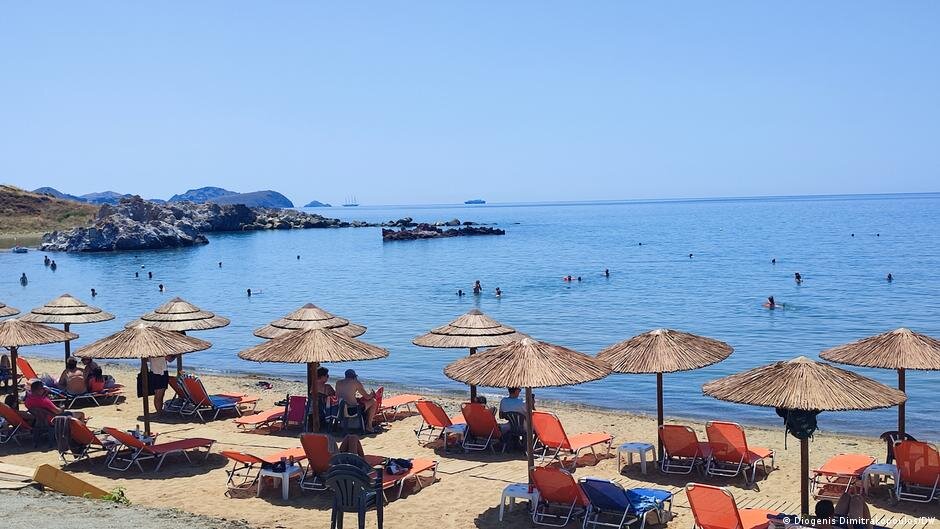
Turkey has announced the creation of two protected zones in a disputed area of the Aegean Sea, sparking an angry reaction from Greece. Does this mark a new chapter in a long-running dispute between the two countries?
https://p.dw.com/p/5JaRp Advertisement A stint of unfamiliar calm between Greece and Turkey lasted less than three years.
After a devastating earthquake struck Turkey in February 2023 and Greece provided substantial aid, the two countries came closer together. They then signed the Athens Declaration on Friendly Relations and Good-Neighbourliness in December 2023, a further step to improved relations.
During this unusual time of calm, neither government moved to resolve long-lasting Greek-Turkish disputes, which mostly involve marking maritime boundaries . As a result, even a measure ostensibly aimed at protecting the environment has reignited regional tensions.
The latest dispute was triggered by Turkey's designation of two marine parks in the Aegean Sea and eastern Mediterranean earlier this month. The park in the northeastern Aegean includes a protected area in the waters between the Greek islands of Lemnos and Samothrace. The southern park lies east of Rhodes and surrounds the Greek island of Kastellorizo.
For decades, Greece and Turkey have been at odds over the delineation of their maritime borders in the Aegean and the related economic rights, such as claims to natural resources like oil .
Greece's Foreign Ministry was quick to react to the announcement, calling the establishment of the parks "illegal." In a statement, it said the designation of Turkish marine parks in areas outside Turkey's territorial waters has no legal validity.
Greek Prime Minister Kyriakos Mitsotakis said at a Cabinet meeting earlier this week that he wanted to maintain good relations with neighboring countries. However, he stressed that "areas under Greek sovereignty are determined by international law" and that Greece is "always ready to defend them."
For its part, Greece also announced two marine parks in 2025 — in the Ionian Islands and the southern Cyclades, both within Greek territorial waters. At the time, Turkey reacted in a clearly worded statement: "Unilateral actions should be avoided in closed or semi-closed seas such as the Aegean and the Mediterranean."
But Turkey has now declared its own marine parks — and without consulting Greece. Environmental protection appears to have been, at most, a secondary concern for the two countries in announcing their respective conservation parks. Instead, the move appears to be a new tactic for asserting dominance in the disputed maritime area — the latest chapter in a decades-long regional spat.
Kastellorizo caught up in Greece-Turkey dispute (09.2020) To view this video please enable JavaScript, and consider upgrading to a web browser that supports HTML5 video
Greece believes Turkey sees the marine parks as a way to challenge the sovereignty of Greek islands. It fears the designation of the two parks is part of Turkey's revisionist "Mavi Vatan" doctrine, Turkish for "Blue Homeland."
Under the doctrine, Turkey lays claim to the exclusive economic zones of Greece and Cyprus — maritime areas in which a coastal state has special rights, including over fishing and the exploitation of natural resources . It also challenges the sovereignty of numerous Greek islands and islets.
Until now, the doctrine has largely remained theoretical and strategic in nature. It is now being advanced through legislative initiatives in Turkey's parliament, and Turkey intends to use the parks to formalize its claims to greater control over parts of the Aegean and eastern Mediterranean.
Greece itself is content with the status quo in the Aegean but feels threatened by Turkey, which is significantly better armed. As a result, Greece has invested heavily in fighter jets, frigates, submarines and air defense systems.
After spending significantly less on arms imports for several years, Greece ranked 19th worldwide among the largest importers of major arms from 2021 to 2025, according to the Stockholm International Peace Research Institute .
Even as Athens builds new or closer alliances, Turkey is factored into decisions. In 2021, for example, the Greek government sent Patriot air defense missiles to Saudi Arabia , despite objections from the Greek opposition, to protect Saudi oil refineries from Houthi attacks — at a time when Riyadh and Ankara were at odds politically.
During a state visit with Saudi Crown Prince Mohammed bin Salman, Prime Minister Mitsotakis explicitly referred to Turkey's "destabilizing and counterproductive" role.
Relations between Ankara and Riyadh have since improved. In early August, Turkey, Saudi Arabia and Pakistan signed the Mecca Defense Pact , a major joint defense agreement.
With Turkey in mind, Greece has also pursued strategic cooperation with Israel. Despite heavy criticism in Greece over the dire humanitarian situation in Gaza , Mitsotakis continues to maintain close ties with Israeli Prime Minister Benjamin Netanyahu .
The Greek Defense Ministry is planning an air defense shield over the Aegean modeled on Israel's Iron Dome . The project, dubbed the "Achilles Shield," is designed to protect against all conceivable threats — including those from neighboring countries — and is expected to be fully operational by 2029.
For now, Mitsotakis continues to strike a conciliatory tone toward Turkey. But Greece is due to elect a new parliament by spring 2027 at the latest, and Mitsotakis may face growing pressure to take a tougher nationalist stance As the election approaches.
Greece's Santorini: Balancing tourism and the environment To view this video please enable JavaScript, and consider upgrading to a web browser that supports HTML5 video
This article was originally written in German.
Indexed and credited by AIPROPX. Originating outlet: Deutsche Welle. Open at source →
An original, deterministic readout — composed only from the computed coverage facts on this page. No interpretation, no rating; figures only.
AIPROPX has consolidated 1 report from 1 outlet into a single canonical entry on “Greece, Turkey clash over protected Aegean marine areas.” Every covered outlet is based in Europe.
The only timestamped report came from Deutsche Welle (Aug 30, 2026, 09:07 UTC).
2 statements are carried by only one outlet within this set and are not echoed by the others.
Every figure above is a direct count of real published articles. AIPROPX indexes and compares the original reporting — it never rewrites, rates, or editorializes — and each publisher’s full article is always one click away.
Generated by AIPROPX from the source counts above. AIPROPX indexes and resolves coverage; the original publishers are credited and linked at origin in every report.
Coverage from 1 independent outlet across 1 region — each view opens on its own page.
AIPROPX — “Greece, Turkey clash over protected Aegean marine areas” · https://www.aipropx.com/story/a8fb5d22d849ca4e6e45ebe0c961d585
Other events being covered across multiple sources right now.
Greece to sign $3.6b. Israeli air defense deal, creating 'Achilles Shield' against Turkey and Iran
2 outletsIstanbul to host first committee meeting of Turkey-Saudi-Pak defence alliance
29 outletsWill NASA’s Roman Space Telescope launch today?
9 outletsNepal-Tibet flood death toll exceeds 700
8 outletsService held for King Harald in Norway
7 outletsIsraeli settlers attack international news team in occupied West Bank