
RESOLVING THE LEDGER
RESOLVING THE LEDGER
Only one outlet has reported this event so far — you're reading it below, credited to its source. AIPROPX is tracking the web for more coverage; as additional outlets confirm it, this becomes a full multi-source story automatically.
By AIPROPX Editorial Desk · Published · Updated
One outlet is reporting this so far. AIPROPX is tracking it and will gather every additional source as it develops — the full multi-source comparison appears automatically once a second outlet confirms it.
Jessica Skalka, 37, rounded the corner of a homemade bar in her dad’s garage, passing a framed collage of cutout newspaper clips marking the end of the 99-day strike at British Petroleum’s Whiting, Indiana, refinery in 2015. A row of championship banners for the Chicago Cubs, Bears and White Sox hung high across one wall, while a light-up “Donnie’s Man Cave” sign glowed nearby. An air conditioner hummed in the corner in the Northwest Indiana home as the first July heatwave pushed outdoor temperatures into the mid-90s.
She picked an empty blue-and-orange Bears-themed bucket from the counter, shook it, and asked, “No candy today?”
“Yeah, well, I’m not working right now,” said Donald Skalka, 62, from across the garage.
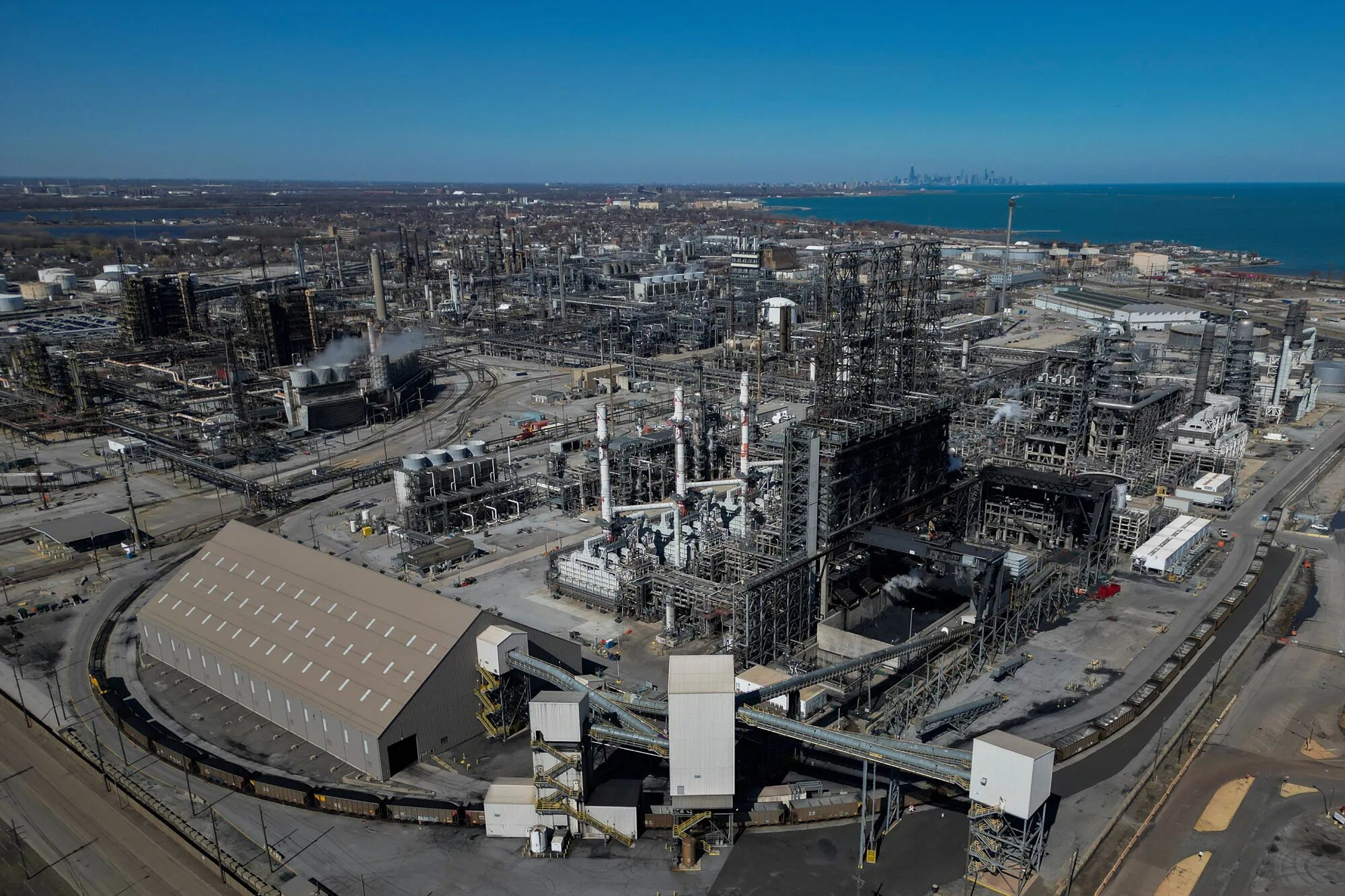
The empty candy bucket was yet another reminder of how much life had changed over the past few months. Until mid-March, father and daughter worked at BP’s sprawling plant in Whiting, Indiana, the largest inland oil refinery in North America, located on the southwestern shore of Lake Michigan, a half-hour drive from downtown Chicago.
The BP Whiting refinery as seen in March. The facility produces approximately 440,000 barrels of crude oil every day.
Erin Hooley / AP Photo
There, Donald had spent nearly two decades working his way up to a job in the control room, where he monitored the refinery’s operations from behind a bank of screens. The plant processed approximately 440,000 barrels of crude oil every day, and Donald kept the electricity and steam-generating machinery at the plant running. Donald’s son worked there, too, as did Jessica, and Donald’s longtime girlfriend, Renee Pleitner, whom he met during his onboarding and is a third-generation refinery worker.
For the last four months, the Skalkas, Pleitner, and approximately 800 other workers represented by United Steelworkers Local 7-1, or USW, have been locked out of the refinery without pay and with no clear indication of when they’ll return to work.
Unlike strikes, in which unionized workers advocate for themselves by refusing to work, lockouts are employer-initiated. During a lockout, management can prevent workers from returning to their jobs to withhold wages. Lockouts are generally seen as a hardline tactic during labor disputes and tend to be rare, especially in the refining business, which requires continuous production and a highly skilled workforce.
Now, longtime refinery workers worry Big Oil is experimenting with a new playbook to break union power, undermine national collective bargaining, and remake its workforce. They also worry that the dispute could have ripple effects far beyond the picket line and threaten not only workers and their families, but the health and safety of the surrounding community — a concern due to four flaring events, a fire, and a major power outage in just four months.
USW Local 7-1 member Alan Leon pickets outside the Whiting refinery in July. Leon is one of 800 unionized BP workers currently locked out of their jobs.
Candace Dane Chambers / Sun-Times.
BP began negotiating with the union in early January ahead of the previous contract’s expiration at the end of the month. But two months into discussions, after 98 percent of USW Local 7-1 members voted to reject what the fossil fuel company called its last, best, and final offer, it issued a lockout order. The proposal would have frozen wages, weakened safety protections, eliminated jobs, and expanded the use of artificial intelligence to monitor employees, according to the union.
In an emailed statement to Grist, BP objected to the union’s characterization of its demands. “Our proposals are not unique or novel,” wrote BP spokesperson Cesar Rodriguez. “Most of what we are seeking has already been tested and implemented elsewhere.”
The lockout also “allowed for a safe and orderly transition of operations,” Cesar said. The union’s 24-hour notice requirement to strike and disrupt refinery operations “presented safety and operational risk,” BP wrote in an earlier statement, and necessitated a continuity plan.
Oil companies have had a banner year following the onset of the U.S.-Israel war on Iran. Chevron, Shell, and ExxonMobil have all reported record-setting profits, making more than $36 billion over the past three months. This week, BP announced quarterly profits of $5.7 billion, more than double the previous quarter.
For Skalka, the March email notifying him that he wouldn’t be returning to work until further notice was gutting.
“The gamut of emotions when I had to face my family, it was a lot,” he said.
From left: USW Local 7-1 members Don Skalka, daughter Jessica Skalka, and girlfriend Renee Pleitner stand outside their home in Munster, Indiana.
Candace Dane Chambers / Sun-Times
Skalka had inspired his children to follow in his footsteps. Born and raised in the northwest corner of Indiana, known for its concentration of factories, steel mills, and refineries, most of his family had worked at industrial facilities. His father worked at cement factories and later built parts for the nearby steel mills. An uncle was a shipbuilder on the East Side of Chicago. He followed suit. After spending a few years working on the railroads, he took a job at Whiting.
He was eventually entrusted with an important role at the refinery. From the control room, he was responsible for identifying broken pumps, mechanical hiccups, and mystery leaks, all of which, if not caught in time, could mean a major fire or a multimillion-dollar headache for BP. Accidents and outages can also spike regional gasoline prices. A power interruption at the facility in April led to gas prices surging regionally by 40 to 80 cents per gallon.
Read Next
New research shows there’s a simple way to protect workers. Is OSHA listening?
Frida Garza
“There’s a little bit of danger to it,” he said. “When you swipe in with your time card, you have to bring your A game.”
All the same, ...
Indexed and credited by AIPROPX. Originating outlet: Grist. Open at source →
An original, deterministic readout — composed only from the computed coverage facts on this page. No interpretation, no rating; figures only.
AIPROPX has consolidated 1 report from 1 outlet into a single canonical entry on “Inside the nearly 5-month labor lockout at an Indiana refinery.” Every covered outlet is based in Other.
The only timestamped report came from Grist (Aug 6, 2026, 08:45 UTC).
2 statements are carried by only one outlet within this set and are not echoed by the others.
Every figure above is a direct count of real published articles. AIPROPX indexes and compares the original reporting — it never rewrites, rates, or editorializes — and each publisher’s full article is always one click away.
Generated by AIPROPX from the source counts above. AIPROPX indexes and resolves coverage; the original publishers are credited and linked at origin in every report.
Coverage from 1 independent outlet across 1 region — each view opens on its own page.
AIPROPX — “Inside the nearly 5-month labor lockout at an Indiana refinery” · https://www.aipropx.com/story/c18f436d10bf6889d147b5d70ea53acc
Other events being covered across multiple sources right now.
Meta wants to get inside your terminal with its new coding agent
5 outletsGoogle Is Killing Google Assistant on Android Devices Next Month
3 outletsUtah Reports Nearly 50 Cyclosporiasis Cases
3 outlets8 big restaurants opened here last month, but 5 closed for good
3 outletsQ&A with Boys & Girls Clubs of Northern Indiana Corridor CEO Duane Wilson
1 outletsCars totaling nearly $200k stolen from dealership