
RESOLVING THE LEDGER
RESOLVING THE LEDGER
Only one outlet has reported this event so far — you're reading it below, credited to its source. AIPROPX is tracking the web for more coverage; as additional outlets confirm it, this becomes a full multi-source story automatically.
By AIPROPX Editorial Desk · Published · Updated
One outlet is reporting this so far. AIPROPX is tracking it and will gather every additional source as it develops — the full multi-source comparison appears automatically once a second outlet confirms it.
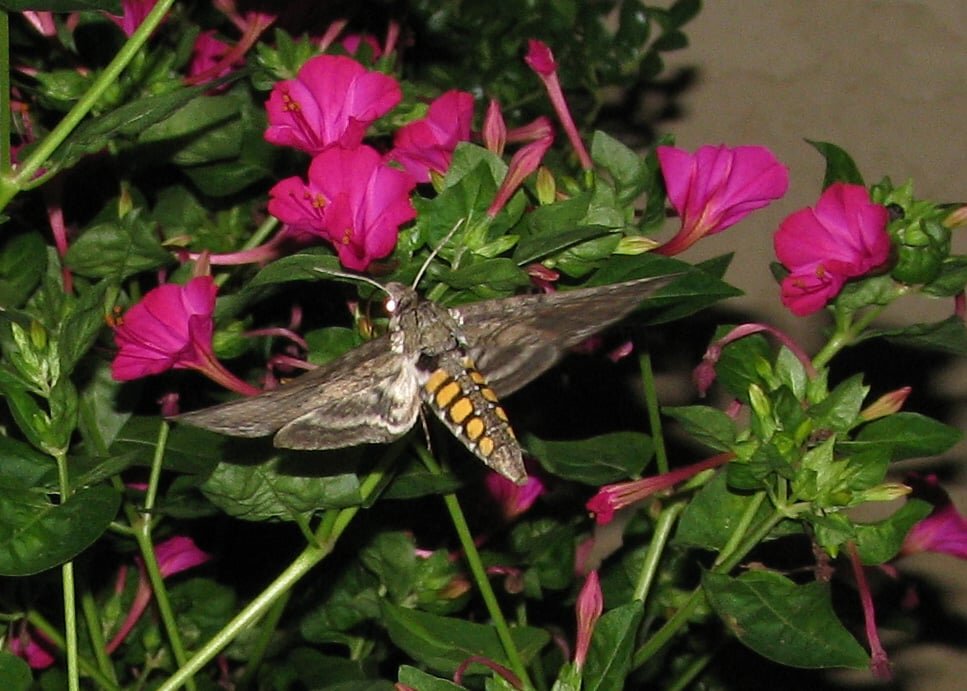
Smell is a complicated thing for insects. Research has shown that, despite limited neural capabilities, insects depend on olfactory cues to locate food, find mates, and avoid predators. Typically, this is done through their antennae, but not always.
For the tobacco hawkmoth, its sense of smell is found in their wings, according to a study published today in the Journal of Experimental Biology. For the latest work, the researchers investigated a previously unexplored function of sensory hairs on the moth’s wings. What they found was that those hairs actively contributed to the moth’s “sense” of smell, not just a simple exchange of chemicals. Further analysis revealed that these hairs reacted to the stinky odor of nightshade plants, the moths’ favorite place to lay eggs.
According to the paper, insect wings carry numerous sensilla, which are tiny receptors shaped either like a small dome or a strand of hair. As sensilla play a key role in insect flight control, research has primarily focused on their mechanical function. Although scientists knew sensilla also had chemical functions, they were more interested in exploring the sensors’ role as “taste bristles,” as the paper puts it.
Then in recent years, researchers found evidence supporting the hypothesis that the yellow fever mosquito’s wings served as an olfactory organ—a “nose.” On the other hand, other research identified similar genes in the wings of the tobacco hawkmoth. Put together, the findings led the team to wonder if the moths were also sniffing things with their wings.
For the study, the team “gently” snipped the edges of the moth wings and sprayed a mist of gold over them. When the researchers placed the wings under a microscope, they saw that, between slender hairs typical of insect wings, there were “stubbier, porous” hairs that “might contribute to the insect’s sense of smell,” according to the statement. Then, they picked out 33 taste and scent receptors, 15 of which were along the wing’s edge, that might be relevant for this sense of smell.
To test whether the hairs were really smelling anything, the team latched an electrical circuit onto the wing to see which scents the wing would react to, or “smell.” Surprisingly, the wing only reacted to two smells common in nightshade plants. The researchers also tried trimming off the edges of the wings to see if the edge hairs were doing most of the work. As it turned out, the wings still reacted to the nightshade scents.
“Most studies on the wing sensory hairs of butterflies and moths have focused on the sense of touch,” Sonja Bisch-Knaden, a study co-author and a biologist at the Max Planck Institute for Chemical Ecology, said in a statement . “This suggests that the moth has special sensory hairs across its wings, not just along the edges, that can smell those odors."
Indexed and credited by AIPROPX. Originating outlet: Gizmodo. Open at source →
An original, deterministic readout — composed only from the computed coverage facts on this page. No interpretation, no rating; figures only.
AIPROPX has consolidated 1 report from 1 outlet into a single canonical entry on “These Moths Smell Flowers Through Their Wings, Study Finds.” Every covered outlet is based in Other.
The only timestamped report came from Gizmodo (Jul 27, 2026, 21:05 UTC).
1 statement is carried by only one outlet within this set and is not echoed by the others.
Every figure above is a direct count of real published articles. AIPROPX indexes and compares the original reporting — it never rewrites, rates, or editorializes — and each publisher’s full article is always one click away.
Generated by AIPROPX from the source counts above. AIPROPX indexes and resolves coverage; the original publishers are credited and linked at origin in every report.
Coverage from 1 independent outlet across 1 region — each view opens on its own page.
AIPROPX — “These Moths Smell Flowers Through Their Wings, Study Finds” · https://www.aipropx.com/story/c4ec095ba46d2e14e58bf2b4ff3ca9e0
Other events being covered across multiple sources right now.
Lindsay Clancy loved her three kids ‘right up to the time of their death,’ lawyer tells jurors at mom’s murder trial
4 outletsSavannah apartment complex residents concerned for their safety
3 outletsCooling centers open across Nashville, Clarksville and Williamson County through Tuesday
3 outletsThe Five': Democratic socialists aren't sugarcoating their agenda anymore
1 outletsSt. Louis chefs share their favorite ways to enjoy summertime peaches
1 outletsNew Indiana law requires schools to teach vaping dangers through mandatory lessons