
RESOLVING THE LEDGER
RESOLVING THE LEDGER
Only one outlet has reported this event so far — you're reading it below, credited to its source. AIPROPX is tracking the web for more coverage; as additional outlets confirm it, this becomes a full multi-source story automatically.
By AIPROPX Editorial Desk · Published · Updated
One outlet is reporting this so far. AIPROPX is tracking it and will gather every additional source as it develops — the full multi-source comparison appears automatically once a second outlet confirms it.
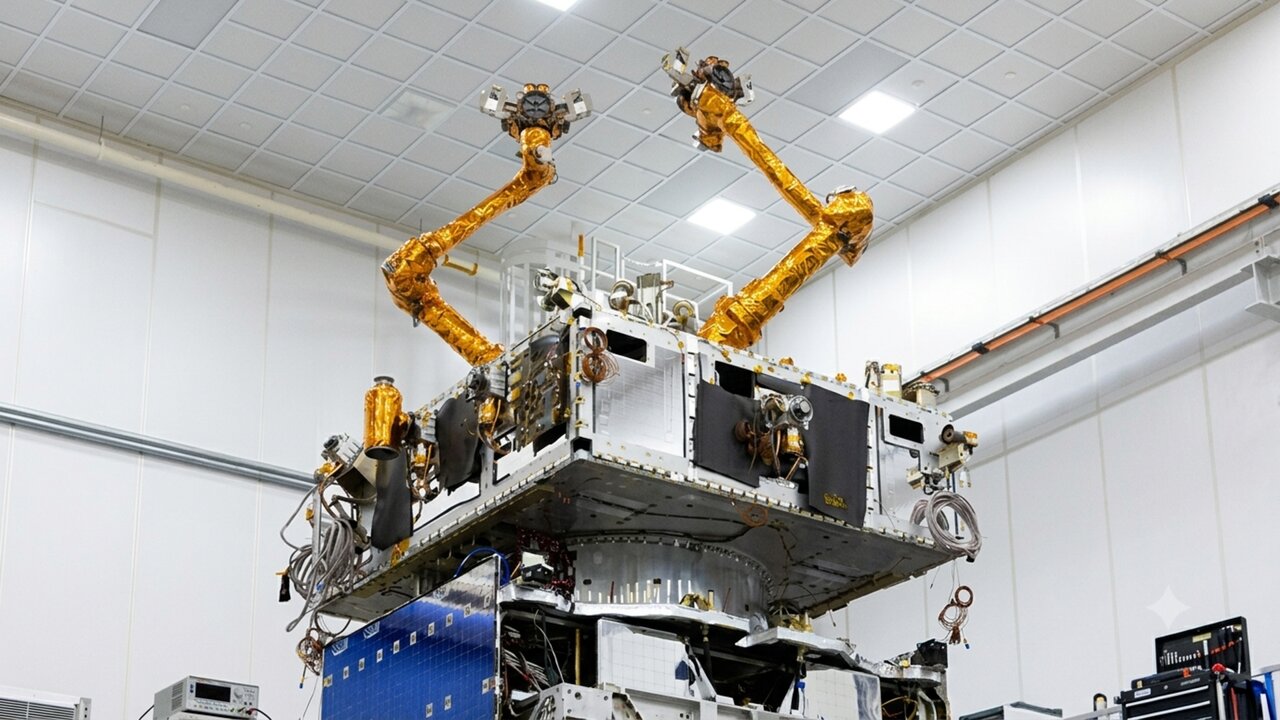
Northrop Grumman's MRV launched with two satellite-servicing robotic arms
Mission Extension Pods can stretch a satellite's working life by eight years
The spacecraft can inspect, refuel, tow, and relocate active orbital satellites or even destroy enemy satellites
Northrop Grumman has launched its first Mission Robotic Vehicle (MRV), equipped with two robotic arms to inspect, repair, refuel, and relocate satellites already operating in orbit.
The spacecraft also carries three Mission Extension Pods (MEPs) that can extend a satellite's operational life by as much as eight years after installation.
Although introduced as a commercial servicing platform, the spacecraft's ability to operate alongside other satellites has already raised questions about possible military applications.
Satellite servicing technology also enables close-proximity operations
The MRV launched aboard a SpaceX Falcon 9 rocket from Cape Canaveral, carrying MEPs intended for commercial satellites operated by Australia's Optus and Luxembourg's SES.
Northrop Grumman says the spacecraft can inspect satellites, install life-extension modules, tow spacecraft between orbital positions, and assist with clearing debris already circling Earth.
Those missions depend on two robotic arms that allow the vehicle to maneuver extremely close to other satellites without relying on direct physical contact.
The robotic arm system was developed through the Robotic Servicing of Geosynchronous Satellites program led by DARPA together with the United States Naval Research Laboratory.
Because those same capabilities allow precise movement around spacecraft, a future version could disable hostile satellites if governments requested such capabilities.
"I will leave it up to the U.S. government to decide how that capability might fulfill mission objectives that they have in that regard," said Northrop Grumman CEO Kathy Warden.
"It's our objective to offer our clients options for technology deployment, and for them to determine policy for when and how they might deploy that technology."
Military officials say orbital threats are already evolving
United States Space Force officials have repeatedly argued that rival nations already possess satellites capable of approaching and interacting with other spacecraft operating in orbit today.
The service says those developments require greater attention because several countries continue expanding technologies capable of operating near valuable military and civilian satellites.
"We're basically responding to a warfighting domain where our adversaries have already put interceptors in space, and we want to make sure that we rebalance that in terms of deterrence," said Chief of Space Operations Gen. Chance Saltzman.
A Space Force spokesperson later cited China's Shi Jian 21 satellite, equipped with a robotic grappling arm, while explaining examples of orbital interceptor capabilities already available.
Officials have also warned that close-proximity satellites could collect intelligence, interfere electronically, damage spacecraft components, or deliberately move another satellite from its assigned orbit.
Those evolving capabilities have prompted the Space Force to expand its focus on orbital warfare alongside traditional space operations.
The service's Space Delta 9 unit develops tactics for both defensive and offensive missions in orbit as those threats continue evolving.
The military is also planning larger space-based defense networks through the proposed Golden Dome missile defense architecture.
The Congressional Budget Office estimates the concept could require about 7,800 space-based interceptors if the program moves forward.
For now, the MRV remains a commercial tool, but how governments will apply comparable space security tech with AI tools and autonomous systems remains to be seen.
Indexed and credited by AIPROPX. Originating outlet: TechRadar. Open at source →
An original, deterministic readout — composed only from the computed coverage facts on this page. No interpretation, no rating; figures only.
AIPROPX has consolidated 1 report from 1 outlet into a single canonical entry on “New US space robot with arms could one day 'close-combat' enemy satellites to mitigate space debris.” Every covered outlet is based in Other.
The only timestamped report came from TechRadar (Jul 26, 2026, 23:25 UTC).
2 statements are carried by only one outlet within this set and are not echoed by the others.
Every figure above is a direct count of real published articles. AIPROPX indexes and compares the original reporting — it never rewrites, rates, or editorializes — and each publisher’s full article is always one click away.
Generated by AIPROPX from the source counts above. AIPROPX indexes and resolves coverage; the original publishers are credited and linked at origin in every report.
Coverage from 1 independent outlet across 1 region — each view opens on its own page.
AIPROPX — “New US space robot with arms could one day 'close-combat' enemy satellites to mitigate space debris” · https://www.aipropx.com/story/d1e9b2dd82c2038383c95f3a5f6e36f0
Other events being covered across multiple sources right now.
For some, so-called 'Skynet Day' came too close to sci-fi after a rogue agent hacked into a startup
2 outletsEurope will one day thank Trump for 'shaking' it out of its 'complacency': UK defense chief
6 outletsSweltering heat wave grips central and southern US for a second straight day
6 outletsIMPACT DAY Through Tuesday: Dangerous Heat & Humidity
5 outletsJana Nayagan' BO day 4: Thalapathy Vijay and Pooja Hegde's film crosses Rs 100cr net
3 outletsOne dead, two injured in Saturday I-59 crash