
RESOLVING THE LEDGER
RESOLVING THE LEDGER
Only one outlet has reported this event so far — you're reading it below, credited to its source. AIPROPX is tracking the web for more coverage; as additional outlets confirm it, this becomes a full multi-source story automatically.
By AIPROPX Editorial Desk · Published · Updated
One outlet is reporting this so far. AIPROPX is tracking it and will gather every additional source as it develops — the full multi-source comparison appears automatically once a second outlet confirms it.
Bats have long posed an immunological mystery: They can harbor viruses that cause severe diseases in other animals, including humans, yet they rarely show signs of illness. Now, scientists have discovered a big clue as to why that is.
Researchers uncovered an unusual feature of bat immunity that could help to explain how these mammals evade infections. Vesper bats , the world's largest family of bats, may possess two separate genetic systems for producing the building blocks of antibodies , the immune proteins that latch onto germs. This configuration has never been found before in mammals.
"It was really surprising," study co-author Hannah Frank , an associate professor of ecology and evolutionary biology at Tulane University, told Live Science. "The only other vertebrates we see something similar in are fish."
The findings, published Wednesday (July 29) in the journal Science Advances , could open new avenues for studying viral infections and the evolution of immunity.
"The study provides a novel view into the evolution and diversity of adaptive immunity in bats," said Daniel Becker , an associate professor of biology at the University of Oklahoma who was not involved in the study. "The duplication seen in vesper bats is really intriguing and suggests that we need more immunological study of this globally distributed family of bats," Becker told Live Science in an email.
'More diversity in their antibodies'
Antibodies are Y-shaped proteins that help the immune system recognize and neutralize foreign invaders, including viruses, as well as other threats, like toxins. Each antibody contains two "heavy chains" and two "light chains," structures that work together to recognize and bind to specific features of viruses, bacteria or other targets.
The tips of the Y shape are responsible for recognizing the targets, while other parts of the antibody help determine how the immune system responds — by blocking pathogens from infecting cells or flagging them for destruction by other immune cells, for instance.
In humans and most other mammals, the genes that build antibody heavy chains are organized into a single region of the genome, called a locus . Cells create a wide range of antibodies by mixing and matching the proteins encoded in different segments of that locus.
But when Frank and her team examined 26 bat species, they found two complete heavy-chain loci located on different chromosomes. The team then showed that both sets of genes were functional and actively used by immune cells to build antibodies. The finding was initially surprising enough that the researchers considered whether it could be an error in how they'd assembled the bats' genomes after sequencing them.
However, Frank's collaborator and former graduate student Dr. Taylor Pursell thought the finding might be genuine, rather than an experimental fluke.
"She said, 'No, Hannah; this is really weird — like, this doesn't happen,'" Frank recalled. "And I said, 'Oh my God; you're right. This is not just an experimental annoyance. This is actually super cool.'"
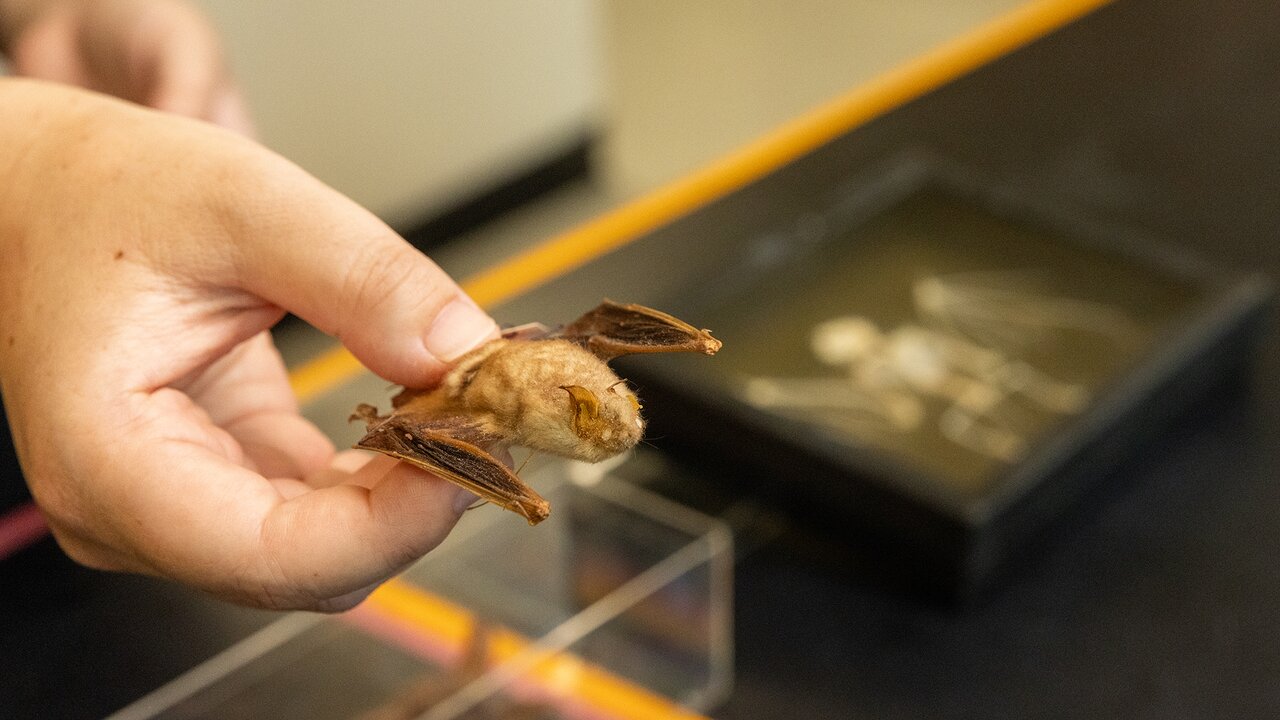
Hannah Frank holds a bat skeleton in her laboratory. (Image credit: Kenny Lass/Tulane University)
Using genetic analysis, the team found that one of the two loci contained a larger and more varied collection of gene segments that could be used to create a broad, ready-made repertoire of antibodies. The other had fewer of these building blocks but appeared to rely more heavily on a process called somatic hypermutation , in which antibody-producing cells make small genetic changes after encountering a pathogen.
Those changes can help antibodies become more "customizable" to whatever threatens the immune system, Frank said.
She compared this system to the different layers of defense seen in the 1998 Disney movie "Mulan." Upon seeing invaders at the Great Wall of China, guards raised an alarm to alert others without yet knowing the specific threat; this is like the innate immune system , the body's first, broad line of defense. The adaptive immune system is more like the heroine Mulan: highly targeted and capable of responding to a specific enemy, but slower to develop.
This study suggests bats have more diversity to start with, which may allow for faster and more effective responses from the start of an infection.
Michael Letko, molecular virologist at Washington State University
These two layers of immune defense are not unique to bats, but bats' two antibody systems may provide an additional layer of protection.
From each loci, bats can create a "cache of trainable, customizable cells," Frank said. This degree of customization could help the bats immune system ward off a wider range of threats than other mammals can.
"This extra set of genes gives the animals more diversity in their antibodies," said Michael Letko , a molecular virologist at Washington State University who was not involved in the study. "This study suggests bats have more diversity to start with, which may allow for faster and more effective responses from the start of an infection," Letko told Live Science in an email.
Letko added that the genetic analysis in the study was impressive and lends credibility to the results. "It is hard to dispute the validity of information solidly founded on the genetic organization of these bats," he said.
That interpretation remains a hypothesis, though; Frank and her team will need to study how these two systems behave when bats are exposed to viruses before they can determine exactly what advantages they provide.
"We think this discovery is an important piece of the puzzle," Frank said in a statement . "It doesn't fully explain why bats are such effective viral reservoirs, but it reveals a level of immune variety we didn't know existed and gives us an entirely new direction to explore."
Past studies of bat immunity have found that hotter body temperatures and a larger number of virus-filled packages in stem cells could also help bats' tolerate v...
Indexed and credited by AIPROPX. Originating outlet: Live Science. Open at source →
An original, deterministic readout — composed only from the computed coverage facts on this page. No interpretation, no rating; figures only.
AIPROPX has consolidated 1 report from 1 outlet into a single canonical entry on “A unique antibody system may help explain bats' unusual tolerance of viruses.” Every covered outlet is based in Other.
The only timestamped report came from Live Science (Jul 30, 2026, 16:53 UTC).
2 statements are carried by only one outlet within this set and are not echoed by the others.
Every figure above is a direct count of real published articles. AIPROPX indexes and compares the original reporting — it never rewrites, rates, or editorializes — and each publisher’s full article is always one click away.
Generated by AIPROPX from the source counts above. AIPROPX indexes and resolves coverage; the original publishers are credited and linked at origin in every report.
Coverage from 1 independent outlet across 1 region — each view opens on its own page.
AIPROPX — “A unique antibody system may help explain bats' unusual tolerance of viruses” · https://www.aipropx.com/story/d6d17a372019253411378f0cd5803f2a
Other events being covered across multiple sources right now.
Trump Says He May Drop Blanche’s Attorney General Nomination, for Now
5 outletsFifteen elephant deaths at Kenya park may be due to cyanide poisoning
4 outletsDes Moines police ask for public's help finding motorcycle chase suspect
4 outletsDangerous heat returns to Kern County; cooling centers may open this weekend
3 outletsHere's who can help locate missing pets following Menasha, Appleton tornado
3 outletsThe cyclospora outbreak is the biggest ever. Why this ‘unusual’ outbreak is so hard to manage.