
RESOLVING THE LEDGER
RESOLVING THE LEDGER
Only one outlet has reported this event so far — you're reading it below, credited to its source. AIPROPX is tracking the web for more coverage; as additional outlets confirm it, this becomes a full multi-source story automatically.
By AIPROPX Editorial Desk · Published · Updated
One outlet is reporting this so far. AIPROPX is tracking it and will gather every additional source as it develops — the full multi-source comparison appears automatically once a second outlet confirms it.
Can Venus cast a shadow? With Aug. 12's total solar eclipse — where the moon's dark silhouette is everything — now behind us, it's a good time to test another kind of celestial shadow.
Astronomical folklore has it that the second rock from the sun, Venus , is, after the sun and moon, the third object able to cast a shadow when it's near peak brightness, albeit extremely faint, according to EarthSky .
Is it true? Not in a city, where skylights glow and porch lights blaze, where shadows are mostly thrown by passing cars that appear to become the brightest object in the solar system briefly. Venus does cast a shadow, but the sky must be very dark, transparent and free of any light — apparently.
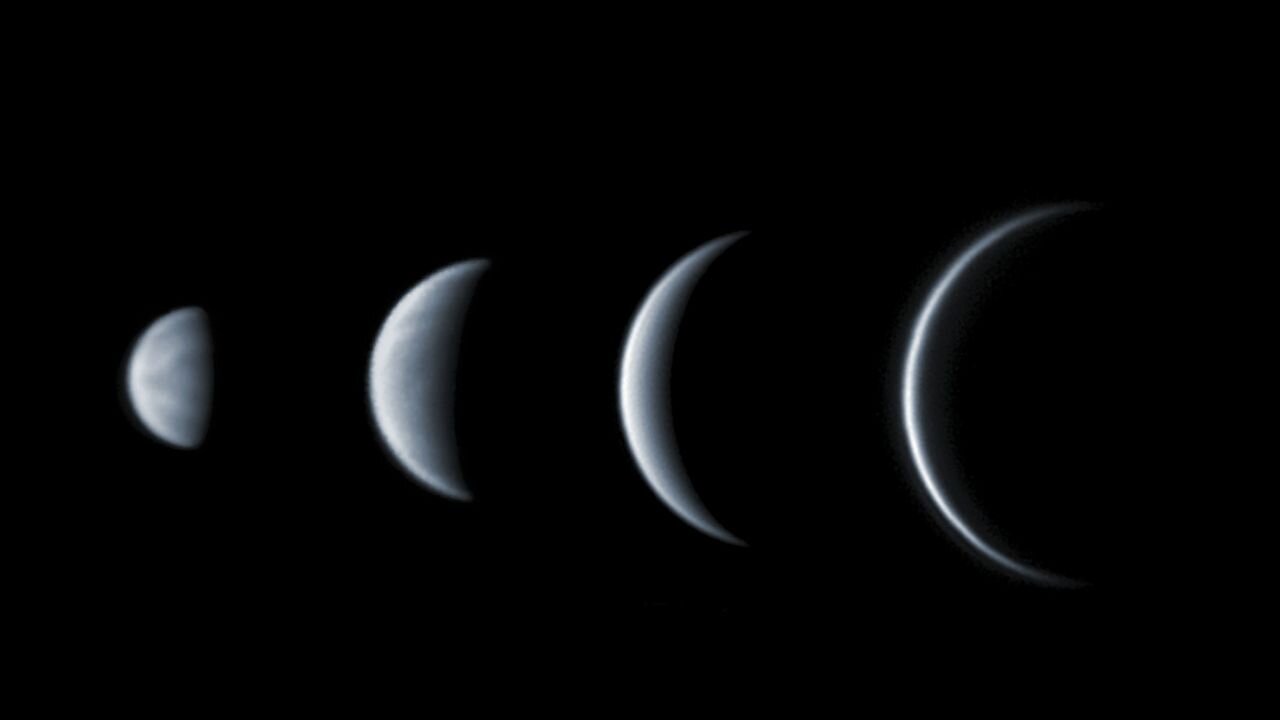
Timing is everything. Having reached dichotomy — its half-lit phase — on Aug. 12, Venus is currently 49%-lit and waning as it moves closer to Earth, increasing in angular size as it becomes a slim crescent. Cue a surge in brightness, thanks to its reflective clouds and its closeness. Shouldn't it be brightest when it's "full?" No, because it's an inferior planet — i.e., it orbits closer to the sun — so it's fully lit only when it's on the other side of the sun from Earth, when its disk appears at its smallest.
What’s happening and when to look
Venus is beautifully placed this week because it reaches greatest eastern elongation, its widest apparent separation from the sun in the evening sky. Look low in the west after sunset — Venus will be the bright white "star" that appears before the fainter stars even have a chance.
On Aug. 14-15, it sits about 46 degrees from the sun and shines at a magnitude of -4.3 to -4.4, bright enough to dominate twilight but not quite at its most impressive stage of the apparition. The real test comes around Sept. 18, when Venus reaches its greatest brilliancy at magnitude -4.6. Sadly, by then it's going to be rather low in the sky from mid-northern latitudes, making observation from the U.K. difficult, but possible from most of the U.S.
Venus shines over the Mitsuke Iwa Rock in Ishikawa, Japan. (Image credit: Yuga Kurita via Getty Images)
How and when I’m watching it
According to Sky & Telescope , to catch a faint but well-defined shadow of Venus — a point source of light — you'll need to be somewhere free from artificial lighting and wait until twilight is over. Face Venus and place a white surface (a white card or sheet works well) also facing Venus. You'll also need to position something in front of the card to cast a shadow. Although it is possible to see the faint shadow of Venus, photographing the card is the best way to capture it, using a technique similar to that for any night sky photograph — a high ISO, a wide aperture and a long exposure of up to 30 seconds. It may be wise to test the location, find the best line of sight, and work out where the card needs to go while Venus is still high enough above the western horizon.
If you're not in a good location to catch the shadow of Venus, instead try to see and photograph the light from Venus reflecting on water. Any pond, lake or ocean you can get between you and Venus ought to catch its shine in a long exposure image. That identical technique — high ISO, a wide aperture and a long exposure — will also apply, but this time you can actually aim your camera at Venus!
Stargazer’s Corner: August 14-20, 2026
This is an excellent week for darkness and faint objects. With new moon on Aug. 12, this week is all about a crescent moon. On Aug. 15 you may catch a 12%-lit waxing crescent close to Venus, but more likely you'll see it on Aug, 16, when it will be 19%-lit. The latter occasion is one to aim for — a beautiful sight. On both occasions, look for "earthshine" on the darkened limb of the moon — sunlight reflected by Earth, and something else you can try to capture with a long exposure. The waxing crescent moon will be low in the western evening sky, but early in the week it sets early enough to leave most of the night usable for stargazing and deep-sky astronomy.
A crescent moon will meet Venus early this week. (Image credit: Jordan Lye via Getty Images)
The buzz around the Perseid meteor shower , like the solar eclipse , will by now have completely dissipated, but they're still active after their Aug. 12-13 peak, though rates will be lower. With the moon mostly out of the way, it is still worth spending time outside after midnight in the hope of finding "shooting stars." However, the main attraction during dark nights in August is the Milky Way, which streams through the Summer Triangle to Scorpius and Sagittarius. Every time I see the Summer Triangle stars high in the night sky, I tell myself that the Milky Way is right there — and hidden from us by light pollution. It's a reminder to get to a dark-sky site as much as possible when the moon is down (the period between last-quarter moon and new moon is the best week of any month).
Constellation of the week: Scorpius
Scorpius is one of the most distinctive constellations visible from mid-northern latitudes, though it never climbs very high. Its bright red star Antares marks the heart of the scorpion, with a curving tail extending downward toward the horizon. You can see Antares above Venus as it gets dark — a bright, dominating star that's a waymarker of summer in the Northern Hemisphere.
The constellation Scorpius. (Image credit: E. Slawik/NOIRLab/NSF/AURA/M. Zamani)
Even in brighter skies, its shape is recognizable, forming a hooked pattern that stands out from the surrounding stars. Because it sits low in the south, it's best observed earlier in the evening before it begins to set. It's one of the few constellations that genuinely resembles its name — and it's where to see the Milky Way meet the horizon.
Indexed and credited by AIPROPX. Originating outlet: Space.com. Open at source →
An original, deterministic readout — composed only from the computed coverage facts on this page. No interpretation, no rating; figures only.
AIPROPX has consolidated 1 report from 1 outlet into a single canonical entry on “Can Venus cast a shadow? Here's how to see it for yourself.” Every covered outlet is based in Other.
The only timestamped report came from Space.com (Aug 14, 2026, 16:00 UTC).
2 statements are carried by only one outlet within this set and are not echoed by the others.
Every figure above is a direct count of real published articles. AIPROPX indexes and compares the original reporting — it never rewrites, rates, or editorializes — and each publisher’s full article is always one click away.
Generated by AIPROPX from the source counts above. AIPROPX indexes and resolves coverage; the original publishers are credited and linked at origin in every report.
Coverage from 1 independent outlet across 1 region — each view opens on its own page.
AIPROPX — “Can Venus cast a shadow? Here's how to see it for yourself” · https://www.aipropx.com/story/d82eb6d8f57c671321c2c5f6057585ba
Other events being covered across multiple sources right now.
People in the US: how do you see the impact of 9/11 on the country and day-to-day life?
8 outletsThe Perseid meteor shower peak was spectacular: Here are our favorite photos
5 outletsBack to School: How AI is being used in the classroom
3 outletsThe Wrong Girls’ Writer-Director & Cast On Stoner Comedy’s “L.A. Accent”, Potential For Sequel: “There’s So Much Left There
3 outletsReddit Joins The S&P 500 Next Week—Here’s What That Means For Shares
3 outletsDraining your pool in Austin? Here's what you need to know