
RESOLVING THE LEDGER
RESOLVING THE LEDGER
Only one outlet has reported this event so far — you're reading it below, credited to its source. AIPROPX is tracking the web for more coverage; as additional outlets confirm it, this becomes a full multi-source story automatically.
By AIPROPX Editorial Desk · Published · Updated
One outlet is reporting this so far. AIPROPX is tracking it and will gather every additional source as it develops — the full multi-source comparison appears automatically once a second outlet confirms it.
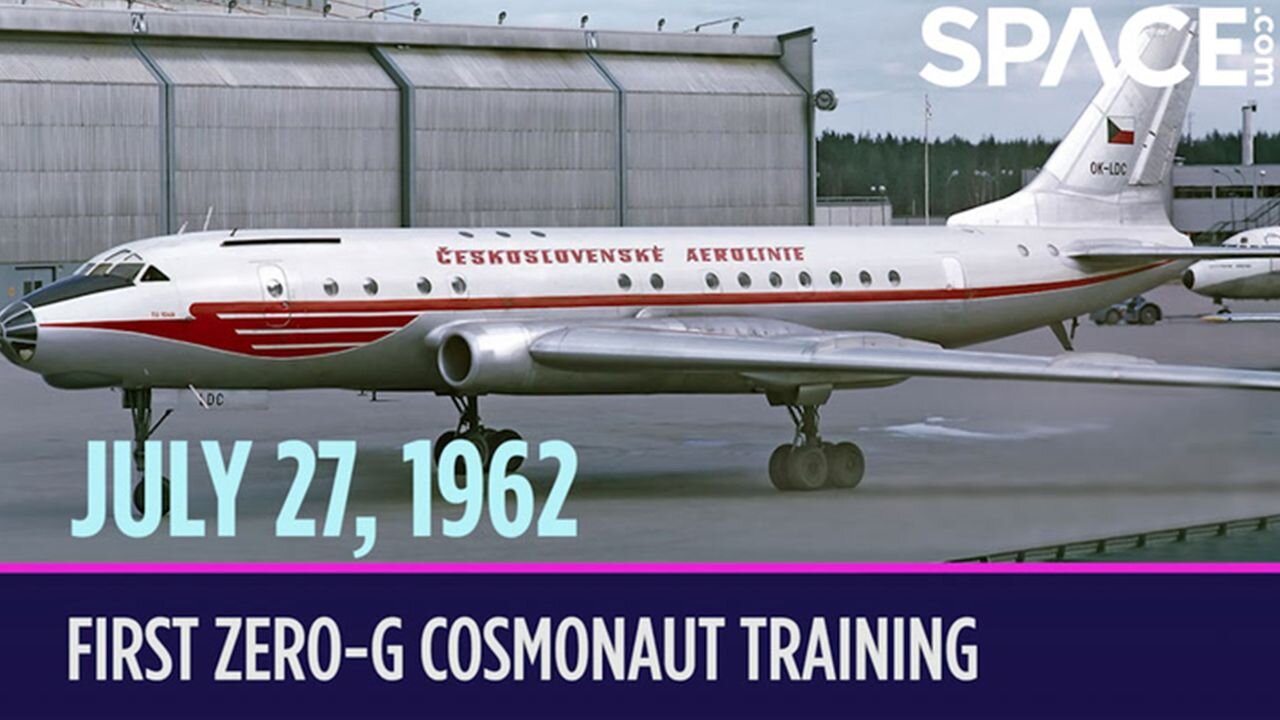
On July 27, 1962, two Russian cosmonauts boarded a Soviet airliner and experienced weightlessness without going to space. This was the first time cosmonauts completed zero-G training on an airplane.
The Tupolev Tu-104 was a type of jetliner originally designed to transport 50 passengers. It was modified to accommodate cosmonauts who needed to train in an environment that simulated weightlessness. By flying in a parabolic arc, passengers could experience 6 to 25 seconds of weightlessness on each maneuver.
Cosmonauts Andriyan Nikolayev and Pavel Popovich were on this flight to prepare for their upcoming orbital missions Vostok 3 and Vostok 4 .
The Soviet Union used a modifed version of a Tupolev Tu-104 commercial jetliner like this one to make the first cosmonaut zero gravity training flight in 1962, (Image credit: Lars Söderström / Shutterstock/ Russia in Space Exhibition (Airport of Frankfurt, Germany 2002))
Why it mattered
Human spaceflight was barely a year old in July 1962, so methods of training cosmonauts (and astronauts) were still in development. In the early days of the Space Age, the effects of weightlessness on the human body — including basic functions like eating and using the bathroom — were still being understood, so the more realistic training could be the better.
For Nikilayev and Popovich, this training was vital. Their Vostok 3 and Vostok 4 missions flew at the same time, marking the first-ever dual spacefligth of two crewed craft (they were single-person capsules). Vostok 2 lasted nearly four days — something NASA would not beat until the Gemini program in 1965 — while Vostok 4 was a nearly three-day flight. The two spacecraft flew within 4 miles of each other during their missions.
Today, NASA and Russia's Federal Space Agency ( Roscosmos ) still train astronauts and cosmonauts on modified jets that simulate weightlessness by flying parbolic flights. You can even buy a ticket to try it yourself through commercial companies like Zero Gravity Corporation , which also flies science flights for NASA.
Want more space history? Check out our full On This Day In Space video archive on YouTube .
Indexed and credited by AIPROPX. Originating outlet: Space.com. Open at source →
An original, deterministic readout — composed only from the computed coverage facts on this page. No interpretation, no rating; figures only.
AIPROPX has consolidated 1 report from 1 outlet into a single canonical entry on “On this day in space! July 27, 1962: The 1st zero-g cosmonaut training flight takes off on a Soviet jetliner.” Every covered outlet is based in Other.
The only timestamped report came from Space.com (Jul 27, 2026, 17:20 UTC).
Comparing the wording across sources, the phrase recurring most across the coverage is “july 27 1962”.
2 statements are carried by only one outlet within this set and are not echoed by the others.
Every figure above is a direct count of real published articles. AIPROPX indexes and compares the original reporting — it never rewrites, rates, or editorializes — and each publisher’s full article is always one click away.
Generated by AIPROPX from the source counts above. AIPROPX indexes and resolves coverage; the original publishers are credited and linked at origin in every report.
Coverage from 1 independent outlet across 1 region — each view opens on its own page.
AIPROPX — “On this day in space! July 27, 1962: The 1st zero-g cosmonaut training flight takes off on a Soviet jetliner” · https://www.aipropx.com/story/dcccbde05c3e13845f781aea3993836c
Other events being covered across multiple sources right now.
Commonwealth Games 2026: Ramsay-Peaty takes bronze in men’s 50m breaststroke final on day four
14 outletsBooks I'm Reading: July 2026
8 outletsOil Prices Sink After U.S. and Iran Pause Fighting a Second Day
5 outletsSpaceX’s stock falls to a new low despite a near-flawless Starship flight
4 outletsOff-duty police officer detains man who attacked three women with knives in Paris
4 outletsMortgage and refinance rates today, Monday, July 27, 2026: Purchase rates higher than refinance rates