
RESOLVING THE LEDGER
RESOLVING THE LEDGER
Only one outlet has reported this event so far — you're reading it below, credited to its source. AIPROPX is tracking the web for more coverage; as additional outlets confirm it, this becomes a full multi-source story automatically.
By AIPROPX Editorial Desk · Published · Updated
One outlet is reporting this so far. AIPROPX is tracking it and will gather every additional source as it develops — the full multi-source comparison appears automatically once a second outlet confirms it.
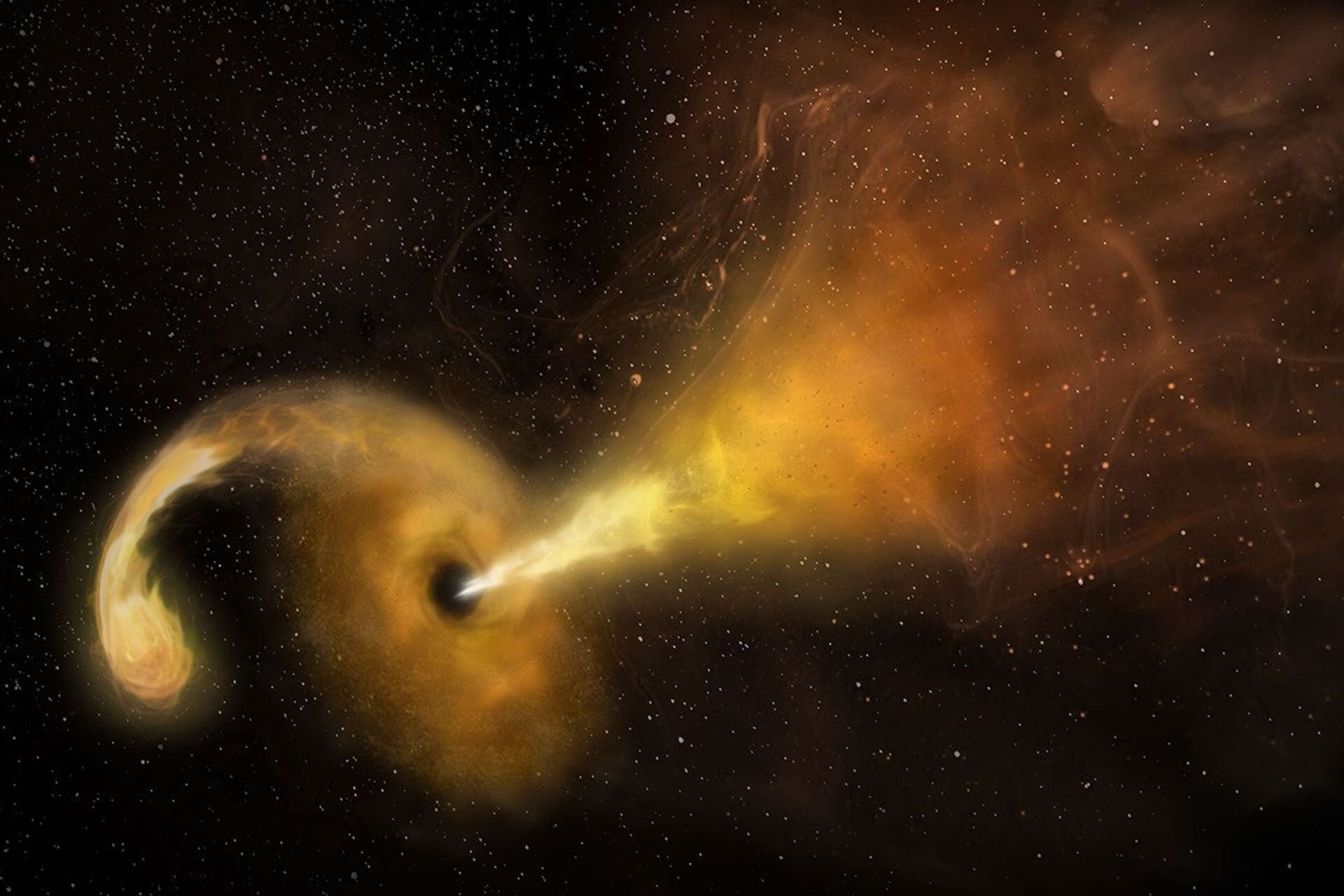
An orphaned black hole that drifted toward the outskirts of its galaxy was caught devouring an unlucky star, revealing itself through a bright flash of light in deep space. The rare cosmic event had never been seen so far outside of a galaxy's core before.
Scientists have long theorized about wandering black holes that may have gotten displaced when galaxies collide or merge together. These dormant objects are rarely seen, however, since they don't emit light by swallowing up surrounding material. That was until researchers caught a bright flash of light released by a star as it was being torn apart, indicating the presence of a supermassive black hole dining on its remains.
The discovery , published in The Astrophysical Journal Letters, could pave the way for the detection of more wandering black holes.
Supermassive blackholes are normally found tucked away at the center of galaxies, gobbling up material with their strong gravitational pull. Some, however, end up drifting in the outer regions of their host galaxies.
The only way to observe these wandering black holes is through a tidal disruption event, whereby a star passes too close to a blackhole and is ripped apart by its gravitational force. Astronomical surveys typically spot around 30 tidal disruption events each year, and scientists have only seen them taking place in galaxy cores.
In November 2025, the Zwicky Transient Facility (ZTF) detected an unusual brightening in a galaxy located about 750 million light-years away. ZTF scans the entire northern sky every two days using the Palomar Observatory in Southern California. To help hone in on a specific light pattern emitted by a tidal disruption event, the researchers behind the new study developed an intelligent algorithm to come through the hundreds of thousands of celestial events detected by the survey.
“Out of the half million flashes ZTF detects each night, our new artificial intelligence algorithm automatically recognized a flare that looked a lot like a tidal disruption event, despite its unusual location in the outskirts of a galaxy,” Robert Stein, a research fellow at the University of Maryland and NASA’s Goddard Space Flight Center and lead author of the new study, said in a statement .
This particular event outshone its entire host galaxy in ultraviolet wavelengths for months, radiating with the light of about 10 billion suns, according to the study.
The researchers used other telescopes, such as the SOAR (Southern Astrophysical Research) telescope in Chile, to gather follow-up observations of the ultrabright flash. They then used NASA’s Neil Gehrels Swift Observatory to look at wavelengths that are otherwise undetectable with ground-based telescopes to gather more data.
“The combination of all this data helped us rule out other explanations and confidently say it’s a tidal disruption event, despite its strange location,” Jonathan Carney, a doctoral student at the University of North Carolina at Chapel Hill and co-author of the new study, said in a statement.
The data helped scientists identify that the culprit behind the bright flash was indeed a blackhole located about 30,000 light-years away from the center of its galaxy. It has around the same mass as the blackhole at the center of our galaxy, the Milky Way's Sagittarius A*, which is around four million times the mass of the Sun.
“To have such a big black hole outside of a galaxy is surprising to me,” Sylvain Veilleux, astronomy professor at the University of Maryland and co-author of the study, said in a statement . “There should be a Milky Way-like object around it—and that's definitely not the case.”
The blackhole likely originated in the aftermath of a violent collision between two galaxies. “It must have originated in a galaxy’s center, but not the one it’s in the outskirts of now,” Stein said. “We think the host galaxy’s supermassive black hole is still at its core, but the one eating the star could have started off in a small galaxy that merged with the big one we see today.”
Another possibility is if three or more galaxies merged together, and the gravitational tug-of-war between each of their supermassive black holes may have flung the lightest black hole far out to the galaxy’s edge.
"Until now, we've started with the assumption that supermassive black holes reside in the centers of massive galaxies,” Suvi Gezari, an associate professor of astronomy at the University of Maryland and co-author of the study, said in a statement. “This discovery will have a huge impact. It means that we're going to find many more examples of wandering black holes, and we can understand how galaxies and their black holes merge and build up over time.”
Indexed and credited by AIPROPX. Originating outlet: Gizmodo. Open at source →
An original, deterministic readout — composed only from the computed coverage facts on this page. No interpretation, no rating; figures only.
AIPROPX has consolidated 1 report from 1 outlet into a single canonical entry on “Astronomers Spotted a Wandering Black Hole at the Edge of Its Galaxy. Then It Found a Snack.” Every covered outlet is based in Other.
The only timestamped report came from Gizmodo (Jul 28, 2026, 19:45 UTC).
1 statement is carried by only one outlet within this set and is not echoed by the others.
Every figure above is a direct count of real published articles. AIPROPX indexes and compares the original reporting — it never rewrites, rates, or editorializes — and each publisher’s full article is always one click away.
Generated by AIPROPX from the source counts above. AIPROPX indexes and resolves coverage; the original publishers are credited and linked at origin in every report.
Coverage from 1 independent outlet across 1 region — each view opens on its own page.
AIPROPX — “Astronomers Spotted a Wandering Black Hole at the Edge of Its Galaxy. Then It Found a Snack” · https://www.aipropx.com/story/e3426fbd5903f122205c6d42023ed599
Other events being covered across multiple sources right now.
Starship’s Heat Shield Looked Great After Flight 13, But Experts Spotted Something Troubling
4 outlets6 Historically Black Summer Getaways You Need To Know About
3 outletsThe Galaxy Z Fold 8 is the modern-day wild Nokia phone and may finally put foldables on the map — but how much credit will…
3 outletsBetye Saar, Leading Figure of the Black Arts Movement, Dies at 99
25 outletsLindsey Graham’s funeral service at Washington National Cathedral
20 outletsTrump Asks Supreme Court to Allow Restrictions on Mail-In Ballots Before Midterms