
RESOLVING THE LEDGER
RESOLVING THE LEDGER
Only one outlet has reported this event so far — you're reading it below, credited to its source. AIPROPX is tracking the web for more coverage; as additional outlets confirm it, this becomes a full multi-source story automatically.
By AIPROPX Editorial Desk · Published · Updated
One outlet is reporting this so far. AIPROPX is tracking it and will gather every additional source as it develops — the full multi-source comparison appears automatically once a second outlet confirms it.
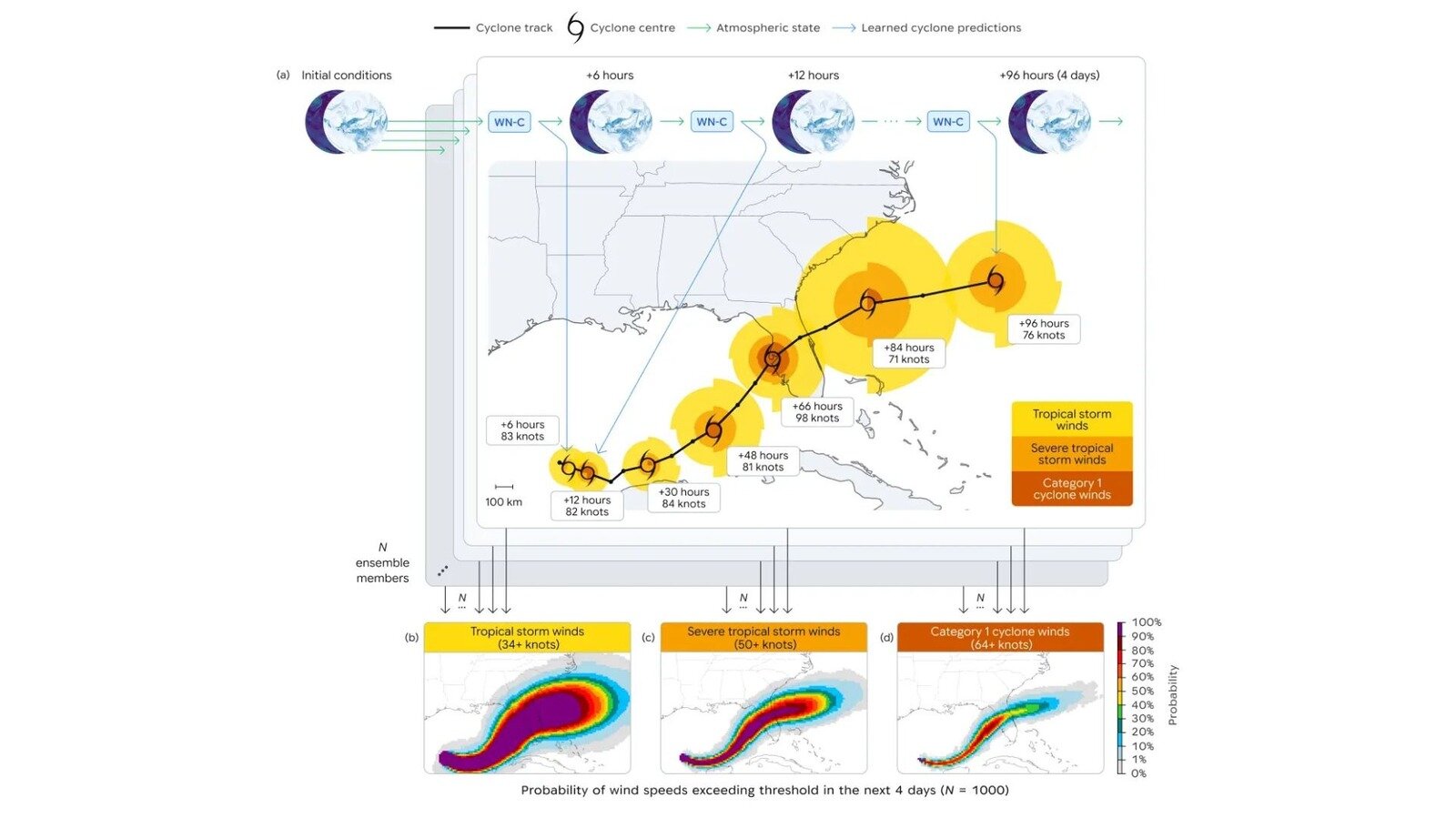
WeatherNext can deliver a 15-day forecast predicting storms’ track and intensity.
Google Researchers from the Google DeepMind and Google Research teams have helped train the WeatherNext AI weather prediction model to offer improved cyclone warnings. The National Hurricane Center, the Cooperative Institute for Research in the Atmosphere, the UK Met Office and other weather agencies around the world also contributed to the model's development. Both the code and the model weights behind the project are being made open source on GitHub , so other scientists can also take advantage of this work.
A study about WeatherNext was published in the journal Nature , and a more layperson version was also shared in a blog post from Google. Tropical cyclones, also known as hurricanes or typhoons depending on where you are in the world, pose a unique challenge to predict because global atmospheric currents that determine a storm's path have traditionally been best analyzed by coarser global models. In contrast, a storm's intensity is best predicted by specialized local models that can assess the thermodynamics processes at the cyclone's core. WeatherNext trained on nearly 20 terabytes of global atmospheric data and historic information collected by the International Best Track Archive for Climate Stewardship to predict both a cyclone's track and intensity with a single model.
"We can now generate a single 15-day forecast in less than a minute on a TPU, empowering forecasters to quickly evaluate the probability distribution of potentially devastating tail-risks," the WeatherNext researchers wrote .
Google introduced the second generation of WeatherNext last year. The company's research teams have also worked on using AI to help predict flash floods .
Indexed and credited by AIPROPX. Originating outlet: Engadget. Open at source →
An original, deterministic readout — composed only from the computed coverage facts on this page. No interpretation, no rating; figures only.
AIPROPX has consolidated 1 report from 1 outlet into a single canonical entry on “Google open-sources an AI model it says can help with earlier hurricane warnings.” Every covered outlet is based in Other.
The only timestamped report came from Engadget (Aug 6, 2026, 22:40 UTC).
1 statement is carried by only one outlet within this set and is not echoed by the others.
Every figure above is a direct count of real published articles. AIPROPX indexes and compares the original reporting — it never rewrites, rates, or editorializes — and each publisher’s full article is always one click away.
Generated by AIPROPX from the source counts above. AIPROPX indexes and resolves coverage; the original publishers are credited and linked at origin in every report.
Coverage from 1 independent outlet across 1 region — each view opens on its own page.
AIPROPX — “Google open-sources an AI model it says can help with earlier hurricane warnings” · https://www.aipropx.com/story/e802b0ae48042243294b1de732b64c05
Other events being covered across multiple sources right now.
Michigan health officials say people can resume regular lettuce-eating habits as new cases of cyclosporiasis slow
4 outletsMeta Says Its AI Model Escaped and Hacked a Third-Party Company Too
3 outletsTrevor Noah is hosting Google’s Pixel 11 launch event
3 outletsGoogle Maps Adds Agentic Feature That Orders Food and Books Hotels for You
3 outletsScientists Trained An AI Model In DNA—And It Invented 16 New Viruses
1 outletsTurn Your Rising Home Equity Into Cash You Can Use