
RESOLVING THE LEDGER
RESOLVING THE LEDGER
Only one outlet has reported this event so far — you're reading it below, credited to its source. AIPROPX is tracking the web for more coverage; as additional outlets confirm it, this becomes a full multi-source story automatically.
By AIPROPX Editorial Desk · Published · Updated
One outlet is reporting this so far. AIPROPX is tracking it and will gather every additional source as it develops — the full multi-source comparison appears automatically once a second outlet confirms it.
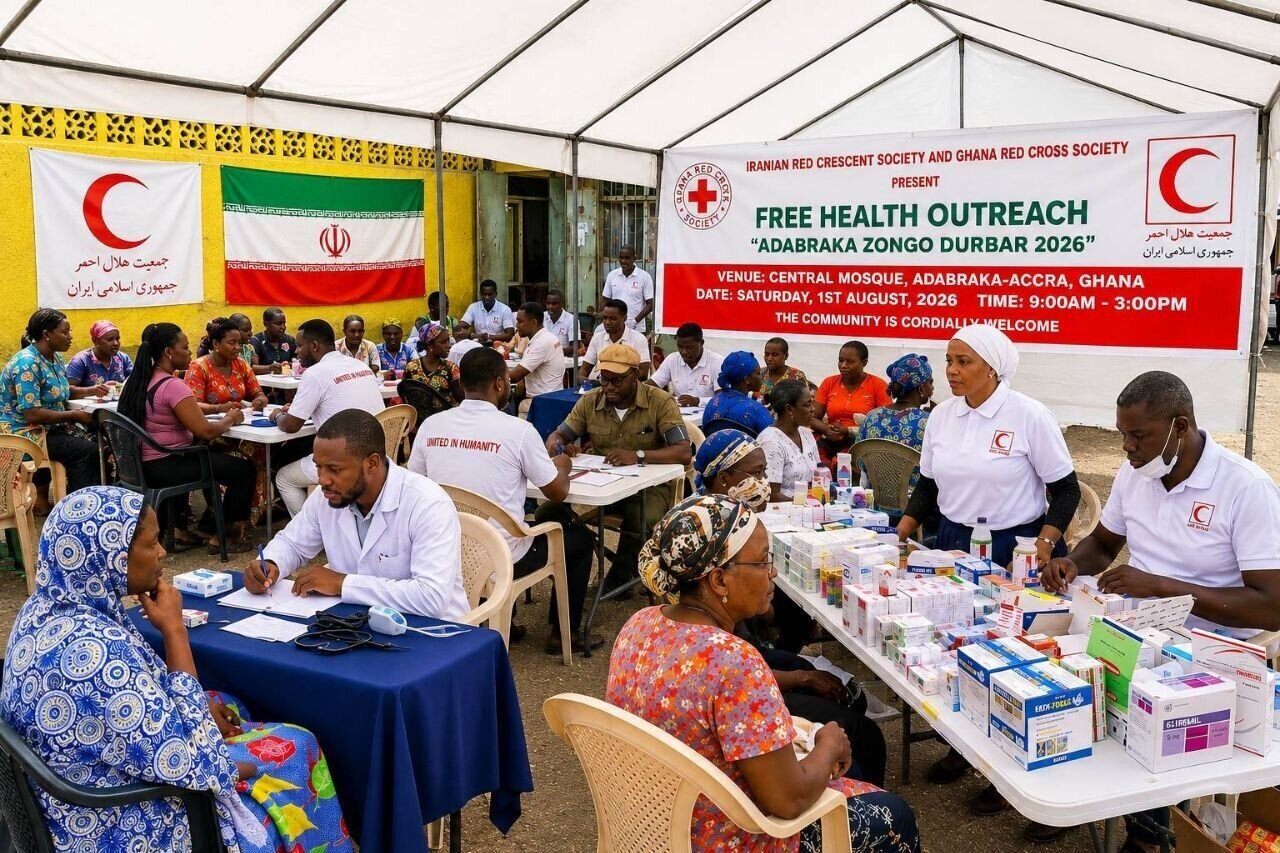
TEHRAN - A one-day medical camp has been organized by the Iranian Red Crescent Society’s health center in Ghana aimed to provide free medical services to flood victims and the needy, benefiting 547 individuals.
The initiative was taken following floods in the city of Accra and a request from the Ministry of the Ministry of Inner City and Zongo Development, IRNA quoted Hamidreza Dehqan, an IRCS official, as saying on Tuesday.
The Iranian Red Crescent Society’s health center was deployed to provide free medical care to those seeking assistance and individuals in need, Dehqan added.
He noted that 547 people benefited from health services during the one-day medical mission. The services provided included general practitioner consultations, medication distribution, pharmacy services, mobile laboratory testing, and counseling on midwifery and hygiene.
The humanitarian activities of the IRCS are not confined by geographical boundaries, Dehqan said, adding: "The presence of the Iranian Red Crescent Society’s health centers in various countries exemplifies the organization's humanitarian approach to addressing the needs of local communities—an approach that prioritizes human dignity, assistance to the needy, and the alleviation of human suffering."
In such programs, providing free medical services to those in need exemplifies altruism and humanitarian responsibility, demonstrating that serving humanity—transcending geographical boundaries—is one of the Iranian Red Crescent Society’s most vital missions, Dehqan stressed.
Referring to the fundamental principles of the International Red Cross and Red Crescent Movement, he noted that humanity, impartiality, neutrality, independence, voluntary service, unity, and universality constitute seven fundamental principles; the implementation of health programs in underdeveloped areas represents the practical manifestation of these principles in the field of service.
He emphasized that a key approach of the Iranian Red Crescent Society in its overseas operations is to simultaneously focus on treatment, prevention, and the promotion of community health.
“In this context, organizing health camps—alongside the ongoing activities of Red Crescent health centers—facilitates access to medical and counseling services for vulnerable groups.”
Pointing to the operations of the Iranian Red Crescent Society’s health center in Ghana, Dehqan stated that the continued presence of IRCS health centers in African nations is part of the Society’s humanitarian mission on the international stage, a presence founded on serving humanity and helping to improve the health of local communities.
In November 2025, Hossam Elsharkawi, the International Federation of Red Cross and Red Crescent Societies (IFRC) Regional Director for the Middle East and North Africa (MENA), highlighted the role of the IRCS as one of the region’s and the world’s key humanitarian actors.
Lauding the IRCS efforts, Elsharkawi congratulated Pirhossein Kolivand’s re-election as the head of the IRCS, saying that the IRCS makes highly effective decisions at international levels, IRNA reported.
The official made the remarks in an online meeting with Kolivand. During the meeting, the two officials discussed ways to foster collaborative efforts, develop rescue systems to enhance the country’s preparedness and response capabilities, and conduct international meetings and conferences in Iran.
The IRCS proposed hosting an international Islamic youth conference and the conference of leaders of national societies from Islamic countries.
The two sides also emphasized the need to implement the previously signed memoranda of understanding between the two organizations to lay the ground for promoting educational, operational, and logistic collaborations.
The IRCS also suggested introducing an expert to follow up on managerial and technical cooperation with the Regional Office for MENA.
Indexed and credited by AIPROPX. Originating outlet: Tehran Times. Open at source →
An original, deterministic readout — composed only from the computed coverage facts on this page. No interpretation, no rating; figures only.
AIPROPX has consolidated 1 report from 1 outlet into a single canonical entry on “Iranian Red Crescent Society offers health services in Ghana.” Every covered outlet is based in Middle East.
The only timestamped report came from Tehran Times (Aug 14, 2026, 11:37 UTC).
Comparing the wording across sources, the phrase recurring most across the coverage is “iranian red crescent society”.
1 statement is carried by only one outlet within this set and is not echoed by the others.
Every figure above is a direct count of real published articles. AIPROPX indexes and compares the original reporting — it never rewrites, rates, or editorializes — and each publisher’s full article is always one click away.
Generated by AIPROPX from the source counts above. AIPROPX indexes and resolves coverage; the original publishers are credited and linked at origin in every report.
Coverage from 1 independent outlet across 1 region — each view opens on its own page.
AIPROPX — “Iranian Red Crescent Society offers health services in Ghana” · https://www.aipropx.com/story/ee9d4559f52b0f1303656e3ccf3f2245
Other events being covered across multiple sources right now.
South Omaha back-to-school event offers free resources to families in need
3 outletsSelena Gomez and her mom accused of fraud over their mental health startup
3 outletsFree Health Fair in Fort Lauderdale
3 outletsNew Hanover County offers back-to-school vaccine clinic for students
3 outletsLatino Connection hosts Latino Health Summit
1 outletsRed skies, lost solar power: Why Australia must prepare for more dust storms