
RESOLVING THE LEDGER
RESOLVING THE LEDGER
Only one outlet has reported this event so far — you're reading it below, credited to its source. AIPROPX is tracking the web for more coverage; as additional outlets confirm it, this becomes a full multi-source story automatically.
By AIPROPX Editorial Desk · Published · Updated
One outlet is reporting this so far. AIPROPX is tracking it and will gather every additional source as it develops — the full multi-source comparison appears automatically once a second outlet confirms it.
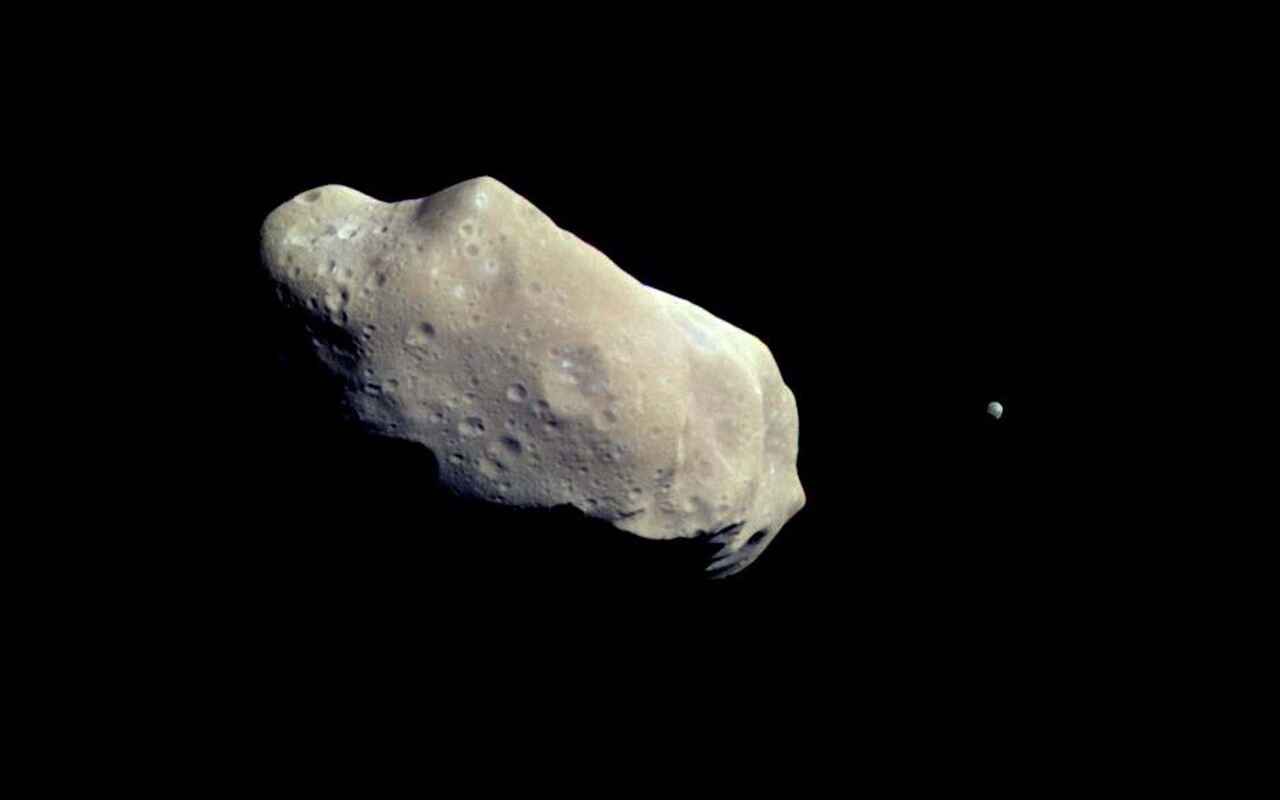
On Aug. 28, 1993, NASA's Galileo spacecraft flew by the asteroid Ida while on its way to Jupiter.
Galileo was the first spacecraft to fly by an asteroid in the asteroid belt . Ida was actually the second one it visited after another flyby of the asteroid Gaspra in 1991.
Galileo whizzed by asteroid Ida going almost 28,000 mph and came within 1,500 miles of the asteroid's surface. During the encounter, Galileo actually discovered a tiny moon orbiting Ida! This was the first confirmed satellite of an asteroid . The International Astronomical Union named the moon Dactyl after a group of mythological beings who lived on a sacred mountain called Mount Ida.
Why it mattered
The Galileo spacecraft, on its way to the Jupiter system, captured this mind-blowing image of asteroid 243 Ida and its moon, Dactyl. (Image credit: NASA/JPL)
Asteroid 243 Ida was actually the second asteroid ever to be visited by a spacecraft (Galileo previously flew by the asteroid Gaspra in October 1991), but this flyby clinched the theory that asteroids could have moons .
Until the Galileo spacecraft photographed Ida and Dactyl, astronomers suspected some asteroids could have their own moons, but Galileo proved it once and for all. During the flyby, Galileo approached within 1,500 miles (2,400 kilometers) of Ida as it made its way to Jupiter .
The greatest asteroid missions of all time!
"It was previously thought that natural satellites of asteroids could form, but they probably weren't common," Torrence Johnson, Galileo's project scientist, once said of the flyby in a NASA statement . "Having found one fairly quickly, we can say that they're probably more common than previously thought."
Ida is an S-type asteroid made mostly of silicate rock and sits in the main asteroid belt. Astronomers suspect it is what's known as a Koronis asteroid, leftover debris from an ancient crash of two much larger objects, according to NASA. It was discovered on Sept. 29, 1884 by Austrian astronomer Johann Palisa at the Vienna Observatory.
Galileo imaging team member Ann Harch actually discovered Ida's moon Dactyl on Feb. 17, 1994, months after the flyby, while reviewing data, NASA said.
Galileo did not stop to study Ida and Dactyl. As with its Gaspra flyby, the probe zoomed by to continue its trip to Jupiter. NASA launched the Galileo mission on Oct. 18, 1989 and it arrived at Jupiter on Dec. 7, 1995, orbiting the giant planet for nearly 8 years. The mission ended on Sept. 21, 2003, when Galileo intentionally crashed into Jupiter .
Want more space history? Check out our full On This Day In Space Story archive and watch our On This Day In Space videos on YouTube .
Indexed and credited by AIPROPX. Originating outlet: Space.com. Open at source →
An original, deterministic readout — composed only from the computed coverage facts on this page. No interpretation, no rating; figures only.
AIPROPX has consolidated 1 report from 1 outlet into a single canonical entry on “On this day in space! Aug. 28, 1993: Galileo spacecraft flies by asteroid Ida on the way to Jupiter only to find a tiny moon!.” Every covered outlet is based in Other.
The only timestamped report came from Space.com (Aug 28, 2026, 14:25 UTC).
Comparing the wording across sources, the phrase recurring most across the coverage is “galileo spacecraft”.
2 statements are carried by only one outlet within this set and are not echoed by the others.
Every figure above is a direct count of real published articles. AIPROPX indexes and compares the original reporting — it never rewrites, rates, or editorializes — and each publisher’s full article is always one click away.
Generated by AIPROPX from the source counts above. AIPROPX indexes and resolves coverage; the original publishers are credited and linked at origin in every report.
Coverage from 1 independent outlet across 1 region — each view opens on its own page.
AIPROPX — “On this day in space! Aug. 28, 1993: Galileo spacecraft flies by asteroid Ida on the way to Jupiter only to find a tiny moon!” · https://www.aipropx.com/story/f75e2fee0551868bbd589ddf7b3bc57a
Other events being covered across multiple sources right now.
Volunteers, projects sought for United Way of North Idaho’s Day of Action
18 outletsNASA telescope honors Nancy Grace Roman, architect of space-based astronomy
10 outletsLindsay Clancy verdict watch: Jurors resume deliberations on Day 23 of murder trial
8 outletsRichmond Food News: Aug. 27-Sept. 2, 2026
5 outletsSioux Falls School District marks first day of school for 2026-27
4 outletsThe 31 Best Deals From the REI Labor Day Sale