
RESOLVING THE LEDGER
RESOLVING THE LEDGER
Only one outlet has reported this event so far — you're reading it below, credited to its source. AIPROPX is tracking the web for more coverage; as additional outlets confirm it, this becomes a full multi-source story automatically.
By AIPROPX Editorial Desk · Published · Updated
One outlet is reporting this so far. AIPROPX is tracking it and will gather every additional source as it develops — the full multi-source comparison appears automatically once a second outlet confirms it.
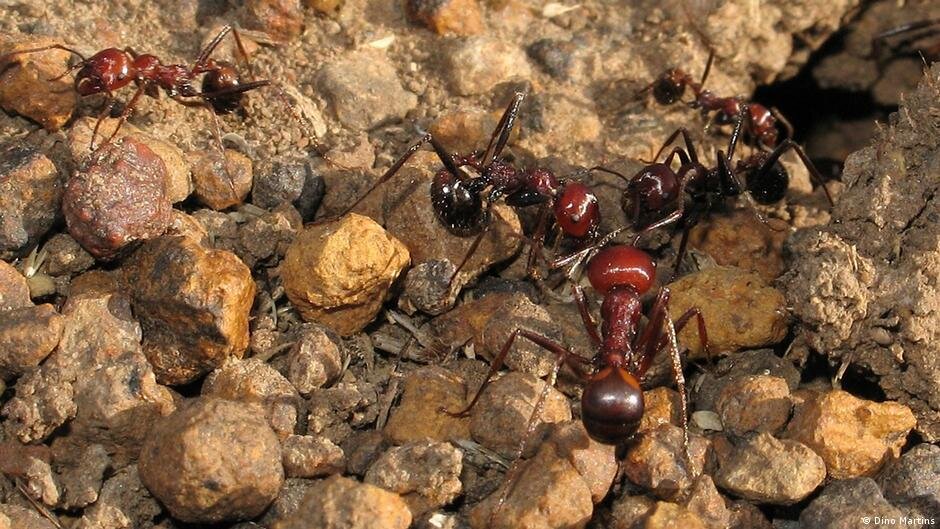
Legal or not, the trade in African ants bound for Europe is booming. What do hobbyists find appealing about these insects, and what risks does the trade pose to ecosystems, including power outages?
https://p.dw.com/p/5I3wH Advertisement They are unusual pieces of evidence that regularly appear in Kenyan courtrooms: thousands of ants packed into tiny containers.
Since 2025, such finds have been presented in court several times. Staff from the Kenya Wildlife Service discovered them during baggage inspections. In multiple cases, they identified thousands of specimens of the sought-after Messor Cephalotes species also known as the Giant African Harvester Ant . A single queen can fetch more than €200 ($230) on the market.
The export of wild animals is generally prohibited in Kenya. Due to high levels of poaching — particularly involving elephants and rhinoceroses — many African countries have introduced tough laws against wildlife trafficking.
Kenya has also tightened its legislation. Under these rules, a Chinese national who attempted to export ants was sentenced last April to one year in prison for biopiracy. Given the growing scale of smuggling and its ecological consequences , the judge said the sentence should serve as a deterrent.
It was already the second major ant-smuggling case in 12 months. The previous year, the wildlife service stopped four men who referred to themselves as the "Ant Gang." Among them were two 19-year-old Belgians who were trying to smuggle 5,500 queens to Europe. They were fined around €5,000 each.
Whenever such cases arise, authorities often call entomologist Dino Martins to the airport. "I was shocked," he said. "Not only by the sheer number of ants, but also because they were queen ants."
The seized insects were young queens that had been dug up from nests in the ground, according to Martins, who has led several research institutes in Kenya and is regarded as one of Africa's leading ant experts, These queens have wings that allow them to fly away and establish new colonies.
"When you collect queens at this critical moment, you interrupt a key stage in the creation of new colonies," he said, adding that Kenya's ecosystems are also affected because ants transport grass seeds, helping to regenerate the savannah.
In Europe, keeping ants as pets has become increasingly popular, particularly among young people. Colonies are housed in glass terrariums where a queen produces offspring and establishes an entirely new population.
One person who keeps ants as a hobby is Michael Meier, who asked not to be identified by his real name. While at university, he wanted a pet that required little attention.
"With ants, it doesn't really matter whether I feed them today or tomorrow," he said.
At one point, Meier kept almost 30 colonies in a room specially set up for them. Today, he has four. He admits that exotic species are considered especially attractive to ant enthusiasts because they do not hibernate.
"That way, you can enjoy the animals all year round," he said.
On the websites of numerous online shops, ants can be ordered through the mail with just a few clicks. "African ants" is a category commonly used to attract customers. Among the species on sale is the very one repeatedly discovered at Kenyan airports.
Anyone who asks dealers how the ants reach Europe receives few answers. Even sellers who advertise "import permits" have declined to answer media inquiries. The trade operates in a legal gray area.
Under the international wildlife trade agreement monitored by the Convention on International Trade in Endangered Species of Wild Fauna and Flora (CITES), ants are not considered a threatened species. Their trade is therefore neither prohibited nor regulated globally.
Kenya, meanwhile, bans the export of all wildlife. But unlike ivory , ants can easily be smuggled out of the country in hand luggage or through the mail.
The online trade in wildlife has expanded rapidly beyond the ant business, says Russell Gray. Working with an international team, he investigated the issue for the Global Initiative Against Transnational Organized Crime.
"The key finding is that this is no longer a marginal problem hidden away on obscure websites," Gray said. "Today, we see it happening on popular platforms such as Facebook."
Last year, Gray's team examined more than 60 online platforms. They found 266,000 advertisements that included prices. The combined value of wildlife listings amounted to around $66 million. Insects were not even included.
"If we looked at the entire online wildlife trade," Gray concludes, "we would probably be talking about a market worth billions."
Chris Shepherd, a biologist at the US-based Center for Biological Diversity, which advocates globally for biodiversity conservation, is deeply concerned.
The Kenyan cases demonstrate that compared with other forms of crime, such as drug trafficking, profits are high while "the risks are significantly lower," he said. Once rare species begin commanding high prices, organized criminal networks become interested in the trade.
Shepherd therefore calls for stricter regulation. In open letters, he has urged CITES to address the ant trade. He is particularly concerned about the consequences for ecosystems.
Those consequences are already making headlines in Germany.
Entire colonies of North African large gland ants regularly cause power and internet outages in southern Germany by nesting inside electrical distribution boxes.
To address the issue, local government representatives from Austria , Switzerland and southern Germany met at an ant conference in the summer of 2025 to exchange experiences.
Climate change, bringing higher temperatures and less frost, has made conditions in Central Europe increasingly suitable for the species.
Shepherd notes that most ants probably arrive in Europe through plant imports rather than the online pet trade. Even so, he argues that the hobby market poses risks as well....
Indexed and credited by AIPROPX. Originating outlet: Deutsche Welle. Open at source →
An original, deterministic readout — composed only from the computed coverage facts on this page. No interpretation, no rating; figures only.
AIPROPX has consolidated 1 report from 1 outlet into a single canonical entry on “Small insects, big damage: The global ant trade is booming.” Every covered outlet is based in Europe.
The only timestamped report came from Deutsche Welle (Jul 31, 2026, 12:20 UTC).
2 statements are carried by only one outlet within this set and are not echoed by the others.
Every figure above is a direct count of real published articles. AIPROPX indexes and compares the original reporting — it never rewrites, rates, or editorializes — and each publisher’s full article is always one click away.
Generated by AIPROPX from the source counts above. AIPROPX indexes and resolves coverage; the original publishers are credited and linked at origin in every report.
Coverage from 1 independent outlet across 1 region — each view opens on its own page.
AIPROPX — “Small insects, big damage: The global ant trade is booming” · https://www.aipropx.com/story/fe6090d54f1fd57b6078a42ccb51dac4
Other events being covered across multiple sources right now.
Stock market today: Dow, S&P 500, Nasdaq set for more gains as Big Tech's AI spending shows no sign of letting up
3 outletsMLB trade deadline tracker: Following every move of the 2026 deadline
3 outletsThe Elder Scrolls Online Delays Big Features After Mass Layoffs: ‘I Expected Drip Feed But This Is Brutal
1 outletsDream Big with a Home Equity Loan
22 outletsAt least 41 people die as thousands cross to Spanish enclave of Ceuta from Morocco
18 outletsAnthropic's Claude AI models breached three real companies during cybersecurity tests