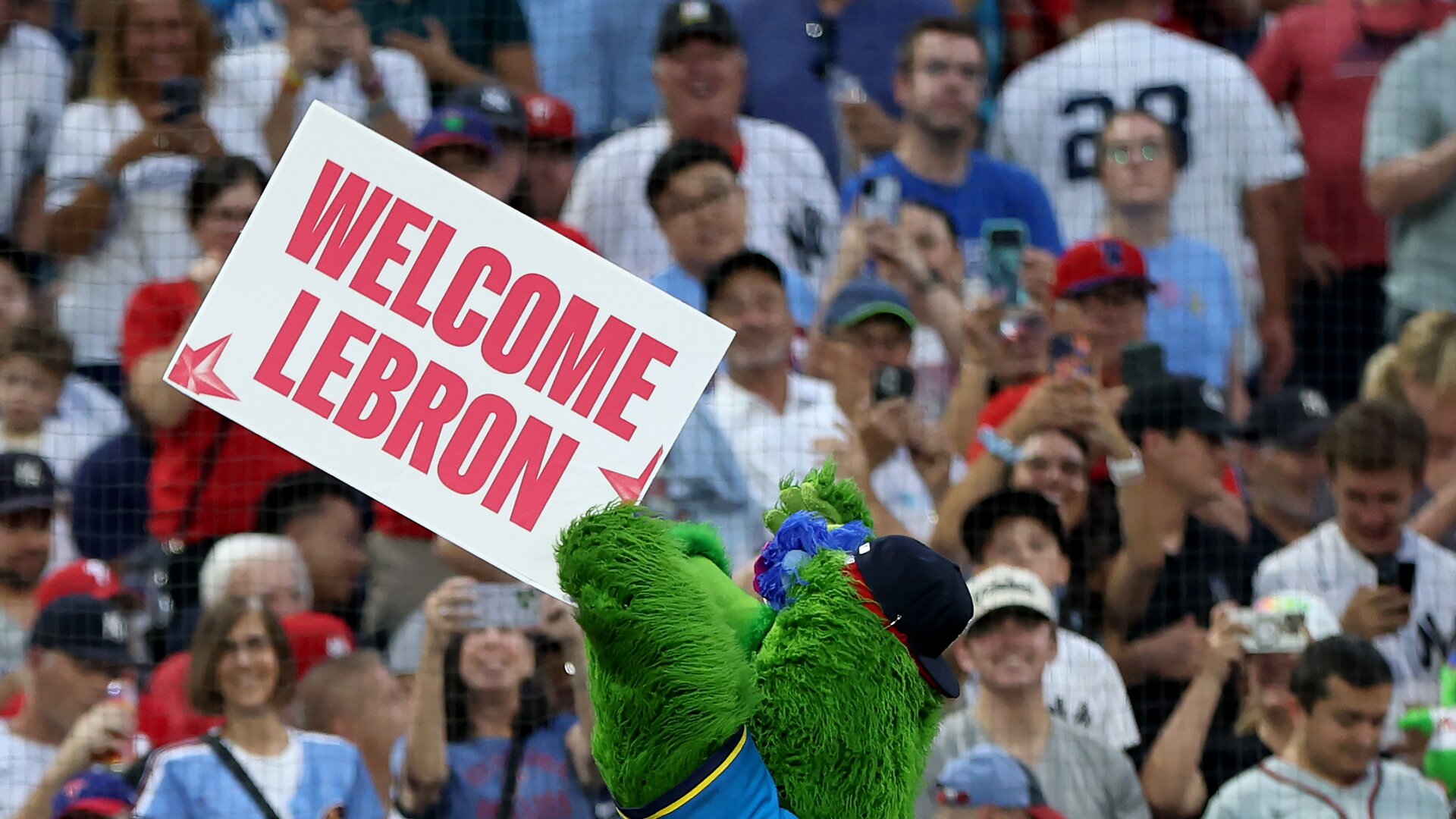
One of the great progressive NBA fantasies is the elimination of conferences. Go to a 1-16 playoff format. Enough with the one or two legit East teams getting to warp their way to the conference finals or, in some seasons, the Finals while their West counterparts are forced to survive three rounds of the Hunger Games.
This isn't going to happen for myriad reasons, chief among them travel and tradition, meaning the NBA's only hope for competitive inter-conference balance lies in the supposed cyclical nature of these things. Wait long enough, and the East will come around.
After 25 years, the wait is over. The Knicks are the champs, LeBron James and Jaylen Brown are in Philly, Kawhi Leonard (we think) is in Toronto, Giannis Antetokounmpo is in Miami, and the East, as a whole, has risen again. It's exciting times. But before we look forward to all that and more, let's take a look back at how ruthless the Western Conference's reign has been since the start of the century.
It's difficult to overstate how lopsided the Western Conference's dominance over the East has been over the past 25-plus years. Dating back to the 2000 Finals, the start of the Shaq-Kobe three-peat, the West has won 17 of the last 27 championships.
That's a simple number, revealing enough, but merely the tip of the iceberg. The issue, as can be seen in the table below, has long lain in the conferences' massive depth discrepancies.
During this span, more than 11,000 inter-conference games were played in the regular season. The West won 55% of them, which came out to nearly a thousand more head-to-head victories. Over the course of those 27 seasons, the East managed a winning record against the West just three times.
In 2007-08, all eight Western Conference playoff teams won 50 games, and from 2004-2011, the West averaged more than seven 50-win teams per season. The depth clearly belonged to the West, but so did the dynasties -- all three franchises that won at least three championships this century ( Lakers , Spurs , Warriors ) hailed from the varsity conference. Then there were the individual honors, which also skewed heavily to the West.
Do the math, and the West has produced 58 more 50-win teams than the East and just shy of 100 more All-NBA players. The West has also accounted for double the MVPs and more than double the first-team All-NBA players, won 63% of the championships, and compiled a 976-win advantage in inter-conference games.
These meager East numbers would look even worse if not for LeBron, who almost single-handedly propped up the conference for the decade in which he went to eight straight Finals (a feat that he never could've duplicated in the West) with the Heat and Cavaliers .
All told, LeBron is responsible for three of the East's 10 post-2000 championships and four of those nine MVPs, with the runner-up in each instance being a Western Conference player. Remove LeBron from the East equation and the West would have a 74% championship rate and an 82% MVP rate over the last 27 seasons.
For narrative's sake, this makes it all the more fitting that LeBron's return to the East coincides with his longtime conference's return to competitive balance, and even that might be a conservative take. Which brings us to ...
This Eastern rise has actually been happening for a while. Dating back to the Raptors ' Finals victory over Golden State in 2019, the East has split the last eight championships with the West. Since 2020, the East has finished with a better record than the West in inter-conference matchups twice after doing so just once in the 20 years prior.
Over this span (2020-present), there have been 24 50-win teams from the West and 20 from the East. Last season, the inter-conference win totals were nearly an even split at 232 for the West and 220 for the East -- which, of course, boasts the most recent champion.
Now let's look at the talent pool. Dating back to 2020, there have been 65 All-NBA players from the West and 40 from the East, which still looks lopsided, but it's important to point out that 10 of those Western spots belonged to LeBron, who now plays in Philadelphia, and Kawhi Leonard, who we presume will be in Toronto next season. Karl-Anthony Towns also collected one of those Western Conference All-NBA slots in 2021-22, when he was in Minnesota.
That's 11 All-NBA slots that have migrated east since 2022. That closes the gap considerably. When the ball tips on the 2026-27 season, 51 of the last 105 All-NBA players (including eight of last year's 15) will be playing for an Eastern Conference team -- nearly an even split with the West's 54.
Indeed, the East is finally back and everyone recognizes it. When LeBron was still a free agent, our CBS Sports Power Rankings had five of the top eight spots designated as Eastern Conference teams heading into next year, and the Sixers are obviously only going up. ESPN's current power rankings have 10 East teams in its top 16. At The Athletic, the East holds claim on nine of the top 15 spots.
At the very least, the days of the Eastern Conference representing a significantly easier path to a championship are over. You could make the case, in fact, that LeBron actually chose the tougher road by going to Philly -- that it's now the Western Conference that is top-heavy with the Spurs and Thunder and the East that boasts superior depth.
Again, look at the numbers. Last year, according to Basketball Reference's adjusted net rating, eight of the top 11 non-OKC/San Antonio teams were in the East. That was before LeBron and Jaylen Brown went to the Sixers and Kawhi went to the Raptors and Giannis went to the Heat. FanDuel has four Eastern Conference teams among its top six 2027 championship favorites.
Nobody is arguing the merits of OKC or San Antonio at the top (except maybe the Knicks, who, you know, just won the championship by way of one of the most dominant playoff runs in NBA history), but after that, it gets a little dicey.
The Nuggets are old ...