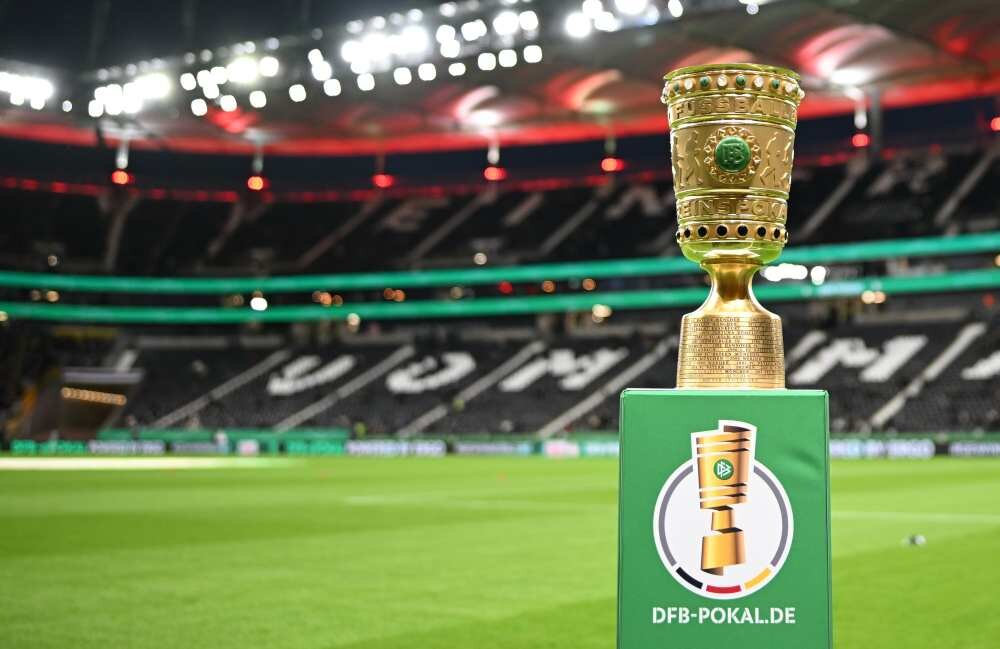
Borussia Dortmund’s DFB Pokal Opponents HEBC Hamburg: ‘This Is Huge, But Next Saturday We’re Back To Fighting Relegation’
By Ben McFadyean.
On Tuesday in the penultimate game of the first round of the German Cup, eight-time Meister Borussia Dortmund travel to Hamburg’s Volksparkstadion. The opponents are not 1983 European Cup winners Hamburger SV, though, but instead a club from the Oberliga Hamburg: Hamburg-Eimsbütteler BC.
Founded in 1911, the club from Germany’s second city has spent most of its existence playing between the Landesliga (VI) and the Verbandsliga (V). A rare high point was in 1982-83 when the Lilla-Weissen reached the county cup final, the Verbandspokal, known locally as the Hamburger Pokal. They lost 5-4 in front of 3400 at the Adolf-Jäger-Kampfbahn, the home of Altona 93, to local rivals Hummelsbütteler SV. After that, the club sank as low as the Kreisliga B, the eighth tier, before getting promoted to the Oberliga in 2020.
The club, who are run by Konstantin Zimmermann, an engineer at national airline Lufthansa, has stayed true to its roots, seit eh und je , which can be translated as, as they always have done.
None of the 28 players of the first team are paid for playing for the club. A far cry from England’s equivalent, the National League, the semi-professional fifth tier in England where players, including former second-tier Southend United and Halifax Town, can earn £6,000 a month – as much as the third tier, 3 Liga, in Germany.
A genuine amateur club
HEBC Hamburg players instead are students, teachers, shift workers and bank clerks. In a time of World Cup tickets at the 2026 tournament in Mexico, Canada and USA costing as much as an astonishing £30,000, this feels like football as it’s meant to be. HEBC play their football on a 3G pitch surrounded by four small stands with a total capacity of 1400 at their Professor Reinmueller Platz. Like most amateur clubs in Germany, their facilities are owned and managed by the local authorities.
The support of the local municipality is what keeps the majority of the estimated 180,000 local football clubs across the country going. The fabled 50+1, the rule which restricts any investor to 49.9% ownership of any football club, may be widely admired outside of the country for ensuring that football stays rooted in the community and protects authentic football culture, also means that far less money comes into the game in Germany beneath the third tier.
Take TV money: the contrast between the Regionalliga , the equivalent to League 2 in England, which in Germany is divided into 5 regions encompassing 80 teams, instead of the 20 in the English equivalent, the average media deal for clubs in the fourth tier is €75,000 per season. This contrasts markedly with League 2, where the current deal is £1.13m per season. It’s not hard to see why so few clubs rise from the depths to the 3. Liga, let alone the top.
2.3m play football at 31,000 registered clubs in Germany; the reality of most players is very much more HEBC than it is recently Bundesliga-promoted Elversberg , let alone HEBC’s cup opponents BVB. On average less than an estimated 0.5% of footballers make it to professional level, most will barely earn anything from their dedication, their commitment and sheer graft they put in week in week at the peak of their powers – the dream however stays alive on the posters that adorn bedroom walls in the homes of young players across the nations: Maybe just maybe if I work hard enough one day I can be the next Serhou Guirassy or Marco Reus.
At his peak, former Germany midfielder Reus, who, in spite of his many honours including one national title and two cup wins, due to injury never got to play in a World Cup, was earning €15m a season. If he had elected to play in the Premier League, he could have earned three times that, but injuries and his commitment to hometown club Dortmund restricted his career earnings. Very few players choose to become one-club legends; Reus played for three (Ahlen, ‘Gladbach and BVB) but 12 out of the total 18 seasons he has played until now were for the 1997 Champions League winners. Most, including the 28 players divided among the first and second teams of HEBC in Germany, play ‘just for kicks’.
This includes 28-year-old Hendrik Diekmann, the tall, dark-haired former club captain, who won’t be out on the pitch at the Volksparkstadion this time around. The former midfielder for Hamburg Eimsbütteler Ballspiel Club (HEBC) has retired—ironically, just months before what could be the biggest match in the club’s history. As a result, when Borussia Dortmund visits Hamburg on Tuesday for the first round of the DFB-Pokal, Diekmann will watch the game as a spectator.
“Borussia Dortmund is a Champions League club. One of Europe’s biggest clubs. That’s where the best players play.” Diekmann says when asked about the cup opponents. Diekmann played a part in the cup victory that got the club into the draw in the first place but retired after the season ended.
He was present at the German Football Museum in Dortmund for the DFB-Pokal draw on June 6th. When referee Deniz Aytekin drew BVB, it was clear to him: “It’s a dream draw, the fixture has brought the club a level of attention it has never experienced before”, he exclaimed when asked about the draw. “A bit more attention will do our club a world of good. We need the reach,” he explained further.
It costs an estimated €200-400,000 per season to run a club in the fourth tier, a lot of money for a club run on the proverbial shoestring like the 2026 Hamburger Pokal winners. This one draw will change the trajectory of the club, maybe forever. Diekmann further: “We plan to update the facilities at the club, lay a new 5G pitch, but we won’t change the culture; we will remain an amateur club, the money won’t change us”. That at least is the hope.
For now, interest in the match is high. Following discussions with Borussia Dortmund, HEBC anticipated an a...