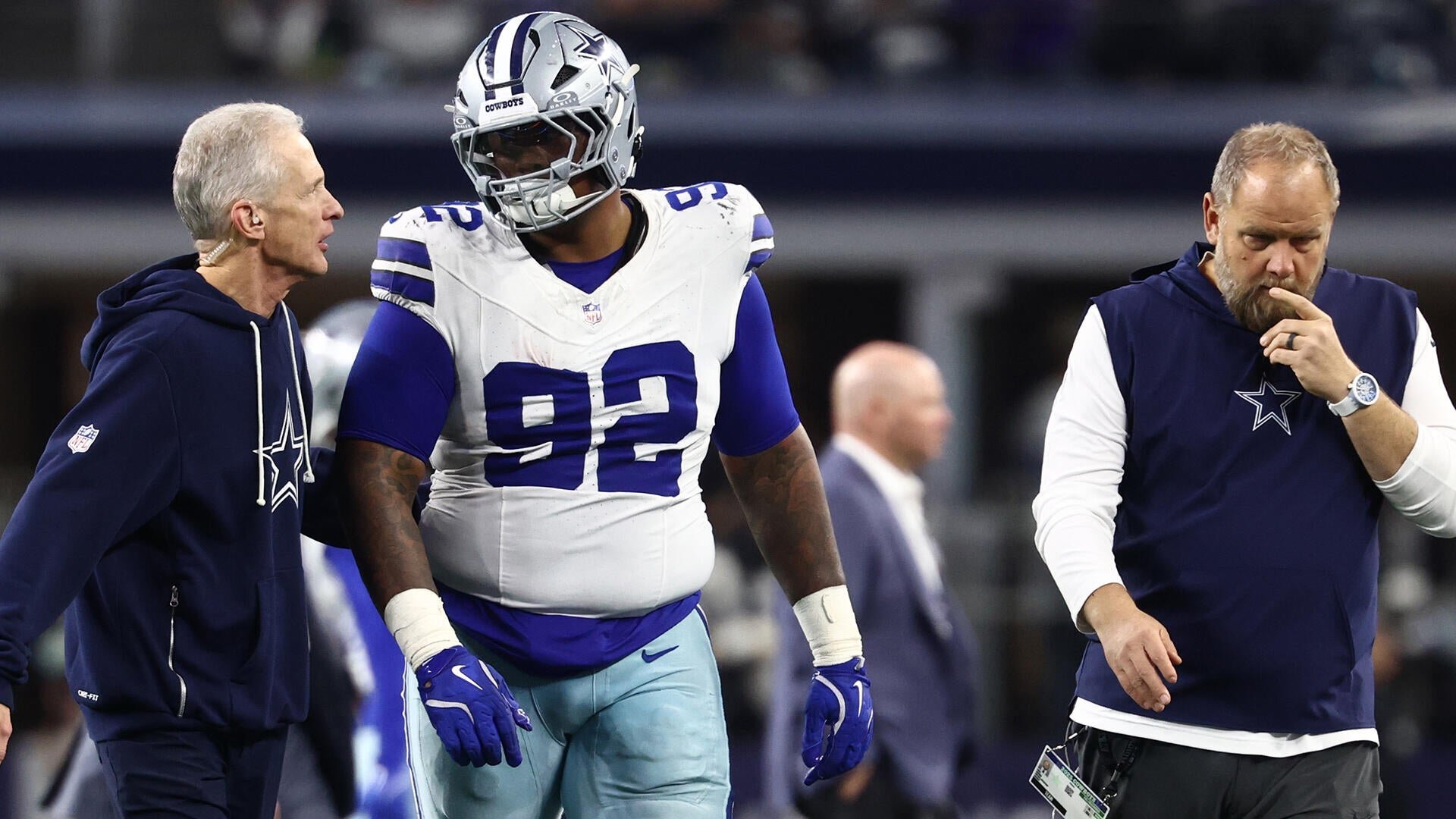
"The early bird catches the worm" does not apply to the Dallas Cowboys ' typical approach to veteran contract negotiations. That's why it was surprising when Cowboys chief operating officer Stephen Jones told reporters at the start of training camp that he had spoken to defensive tackle Quinnen Williams ' agent, Nicole Lynn, about a contract extension.
"We're very open to that," Jones said. "We want Quinnen here for the long haul. Obviously, we have a lot of resources tied up in him. … Certainly, he's at the top of the list in terms of people we want to keep around here long term."
The feeling is mutual as Williams wants to stay in Dallas. He said his focus is more on winning than on a new contract.
Williams, who is 28, has two years remaining on the four-year, $96 million contract extension he signed with the New York Jets in 2023. He is scheduled to make $21.75 million this year and $25.5 million in 2027.
The Cowboys rarely extend players when there are two years left on a contract. Most notably, running back Ezekiel Elliott forced Dallas' hand with a lengthy training camp holdout in 2019. The Cowboys made offensive guard Tyler Smith the NFL 's highest-paid interior offensive lineman last September, shortly after the 2025 regular season started, with a four-year, $96 million extension.
Despite a more accelerated negotiating timetable by Dallas standards, the Cowboys are still being reactive instead of proactive with Williams. The top of the interior defensive lineman market had been stagnant ever since Chris Jones signed a slightly backloaded five-year deal averaging $31.75 million per year with the Kansas City Chiefs in March 2024.
It should have been apparent that a market reset was forthcoming. The gap between the highest-paid edge rusher and the highest-paid interior defensive lineman widened significantly, with the top of the edge rusher market collectively moving 36.76% in 2025 from $34 million per year to $46.5 million per year. The difference between the top of these two markets was 46.46% at the start of the offseason. It was 7.09% when Jones signed his contract.
The Philadelphia Eagles have historically been one of the league's most proactive teams in signing players to contract extensions. Philadelphia began locking up core players well in advance of free agency during Joe Banner's tenure as team president, a practice that included the Eagles advancing to five NFC Championship Games and one Super Bowl in an eight-year span during the 2000s.
It has continued under GM Howie Roseman, who has seen the Eagles win Super Bowl LII and Super Bowl LIX while guiding the front office after regaining power following coach Chip Kelly's firing towards the end of the 2015 season.
Roseman promptly extended the contracts of offensive tackle Lane Johnson and tight end Zach Ertz, Philadelphia's 2013 first- and second-round picks, in January 2016, before that season's playoffs ended. More recently, the Eagles gave wide receiver DeVonta Smith , 2021's 10th overall pick, a new deal in April 2024.
Roseman also stunned the NFL world by upgrading the three-year, $37.75 million contract (worth up to $46.75 million through incentives and salary escalators) for Saquon Barkley after his first season in Philadelphia. Barkley became the league's first $20 million-per-year running back in March 2025 when he signed a two-year, $41.2 million extension, worth up to $56.2 million through incentives and salary escalators.
Because of this, Dallas should have anticipated a contract extension for Jalen Carter , whom the Eagles selected ninth overall in 2023's NFL Draft , and tried to get ahead of it. After Roseman briefly made Jordan Davis the NFL's highest-paid nose tackle with a three-year, $78 million extension in March, it should have been apparent that the same was going to be done for Carter with the interior defensive linemen generally when he signed a new deal.
Jones' public comments about being interested in a Williams deal were on the heels of Carter's new contract. Carter signed a four-year, $152 million extension with $106.9 million in guarantees, a record for interior defensive linemen.
The Cowboys didn't give a 2026 second-round pick, a 2027 first-round pick, and defensive tackle Mazi Smith , who was a 2023 first-round pick, to the New York Jets last November at the trade deadline for Williams to be a short-term rental. Williams made his presence felt after the trade. His 16.3% pressure rate led interior defensive linemen beginning with when he first took the field for the Cowboys in Week 11, according to the NFL's Next Gen Stats. Per Pro Football Focus, Williams had the second-best run stop percentage for interior defensive linemen at 14%.
The Cowboys helped address a logjam on the interior of the defensive line by trading Osa Odighizuwa to the San Francisco 49ers for a 2026 third-round pick in March. That was the optimal time to begin contract discussions with Williams.
The draft capital to obtain Williams already gave him substantial contract leverage. The Odighizuwa trade gave Williams more leverage. Shortly thereafter, Dallas announced there wouldn't be negotiations for a long-term deal with wide receiver George Pickens , who was given a $27.298 million franchise tag.
Making Williams an early offseason priority may have meant a new deal for just over $34 million per year, making him the highest-paid non-quarterback on the team ahead of wide receiver CeeDee Lamb and establishing a new salary benchmark for interior defensive linemen. An unanticipated intervening event was the Tennessee Titans giving Jeffery Simmons , who is 29, a three-year, $105.8 million extension in June. His $60.2 million fully guaranteed at signing is the most ever for an interior defensive lineman. Simmons had two years remaining on his contract, just like Williams has now.
There's another defensive tackle deal on the horizon that could impact Williams' negotiations. The Seahawks are reportedly trying to g...