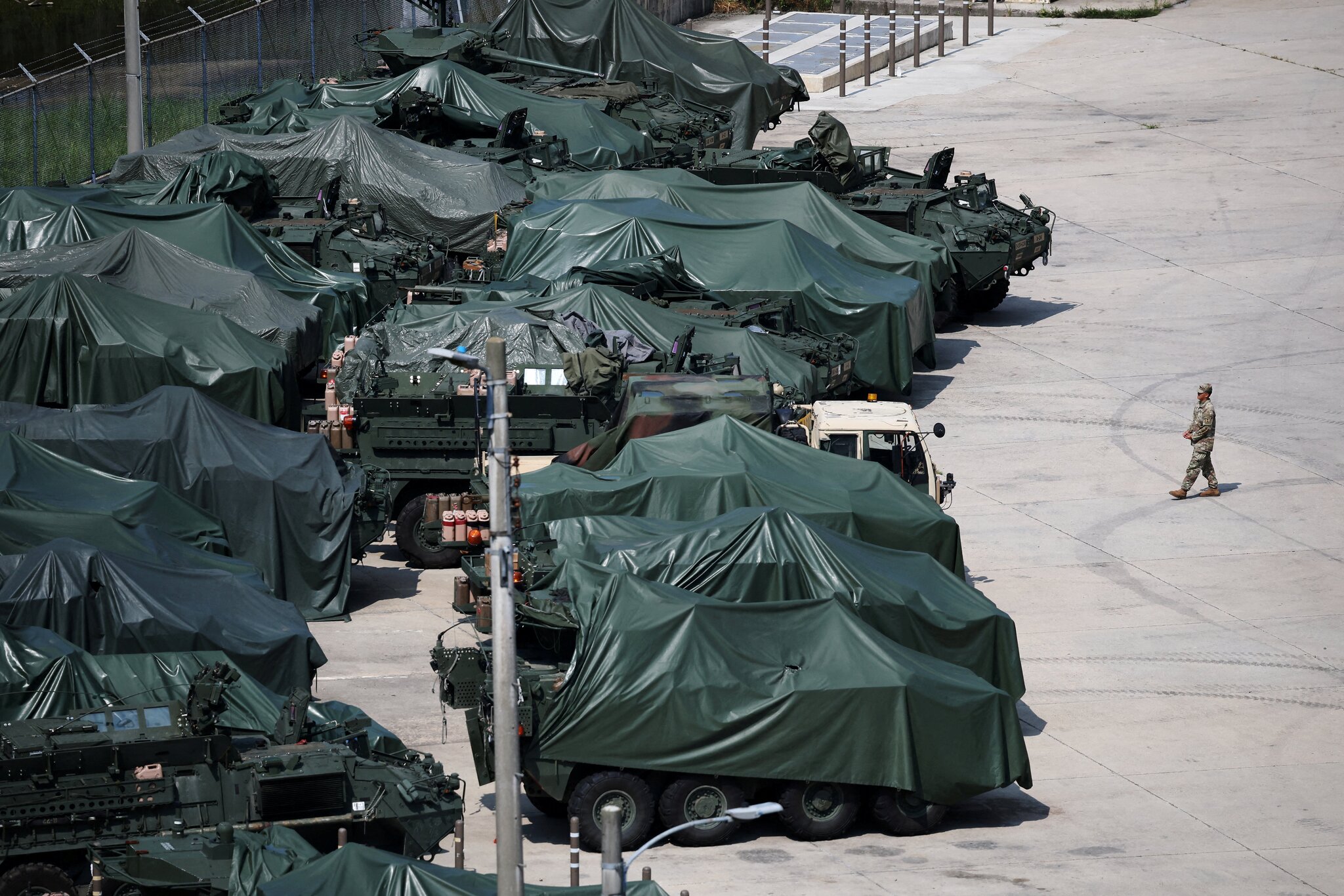
President Trump is straining one of America's closest alliances after scaling back joint military exercises with South Korea. He cited their cost, his relationship with North Korean leader Kim Jong Un and Seoul's refusal to join the Iran war. It's the latest example of Trump taking a transactional approach to alliances. Geoff Bennett discussed more with retired Navy Rear Adm. Mark Montgomery. Geoff Bennett: President Trump is putting new strain on one of America's closest military alliances and raising broader questions about what the U.S. now expects from its allies. The president has ordered the Pentagon to substantially scale back joint military exercises with South Korea, citing their cost, his relationship with North Korean leader Kim Jong-un, and Seoul's refusal to join the U.S. effort against Iran. President Donald Trump: Why are we doing it? So all I want is fairness. And South Korea, I get along with them very well. But we can't go around and protect all of these countries, especially when they're not there to help us. Geoff Bennett: The annual drills are a cornerstone of the decades-old alliance intended to prepare American and South Korean forces for a potential conflict with the nuclear-armed North. Mr. Trump's decision has prompted fresh questions in Seoul about America's reliability as a security partner. President Lee responded earlier today. Lee Jae Myung, South Korean President (through interpreter): A strong South Korea-U.S. alliance in strengthening our independent defense capabilities are mutually reinforcing. A strong alliance makes the foundation of security stronger, and strengthening our own capabilities increases our value and necessity as an ally. Geoff Bennett: The dispute is the latest example of President Trump taking a more transactional approach to traditional alliances, pressing partners not just to spend more on their own defense, but to support U.S. priorities elsewhere in the world. For more, we're joined now by retired Rear Admiral Mark Montgomery. He's had a 32-year career in the U.S. Navy, served on the National Security Council staff, and later as policy director on staff of the Senate Armed Services Committee. He's now a senior fellow at the Foundation for Defense of Democracies. Thank you for being with us. Rear Adm. Mark Montgomery (Ret.), Foundation for Defense of Democracies: Thank you for having me. Geoff Bennett: President Trump linking military cooperation with South Korea to Seoul's decision not to support the war in Iran, how significant a shift is that in the way the U.S. manages alliances? Rear Adm. Mark Montgomery (Ret.): This is really unusual. I mean, the United States -- throughout my whole military career, and I think in general, the United States has always said one of our greatest strengths are our allies and partners. We should be leveraging them, not punishing them. And in this case, South Korea has a significant challenge to face in North Korea. North Korea is getting stronger and more powerful because of its relationship with Russia and its contributions to the Russian war effort in Ukraine. And they have a greater threat to South Korea right now. So South Korea is really trapped on the peninsula worried about North Korea. So I think it's very inappropriate for the president to try to transactionally place South Korea in extremis for their failure to support Iranian -- operations in Iran. Geoff Bennett: Well, what's the through line here? Do you see an identifiable strategy, or is this policy being driven by the president's own relationships, grievances, preferences, and instincts? Rear Adm. Mark Montgomery (Ret.): I would say yes, yes, yes, and yes. And what I mean is, he actually did this in 2019 as well. He believes he has this kind of personal relationship with other -- with authoritarian leaders, and that he can somehow change them. Kim Jong-un is not going to give up his nuclear weapons. He's not going to come to an agreement with South Korea. And the president's not going to get a Nobel Prize, going to negotiate some big deal with North Korea. And what he's really doing is working with one of the members of the kind of axis of aggressors that's challenging the United States around the world, whether it's in China with Taiwan or Russia and Ukraine in Eastern Europe or North Korea and South Korea. So he's really -- he's really trying to work with the other team and not with his allies and partners in South Korea and Japan. Geoff Bennett: I want to return to this word transactional. How do you distinguish between effective burden-sharing and an alliance becoming transactional? Rear Adm. Mark Montgomery (Ret.): But, first, let's be clear. The president was correct in his criticism of Europe and even Japan, Taiwan, Korea at some point. They were not spending enough on defense. Particularly in Europe, they were down in the below 2 percent on average before he started to complain about it in 2017 and 2018. And they have changed, mostly because of Putin's invasion of Ukraine, but also because of their own investment. So he has achieved something there. But the problem is, not everything is this -- is a -- can be viewed for the prism of, you support me here, I will support you there. And his attacks on -- his threatening of Greenland, his disinvestment from Ukraine, they really send a strong signal that the United States is not a credible partner in Europe, for example. This removing -- dropping out of these critical exercises that drive U.S. and Korean force readiness sends a strong signal that we're not a credible partner to Korea, Japan, and Taiwan. There's a real risk in this transactional approach that far exceeds the benefit of getting them to spend a little more money on their defense. Geoff Bennett: And what does China learn from tensions between Washington and its Asian allies? Rear Adm. Mark Montgomery (Ret.): Well, China's learning that we're easy to distract. I mean, we have been just distracted in Europe and Ukra...