QUICK FACTS
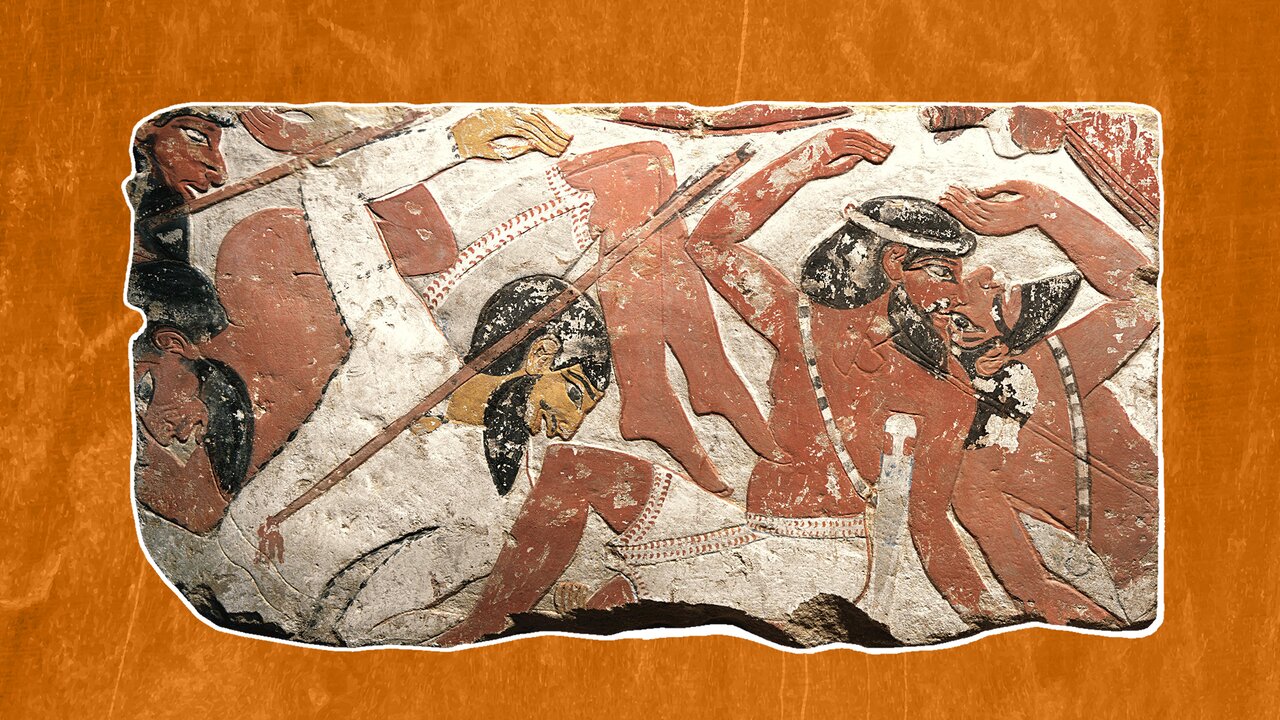
Name: Relief fragment with vanquished enemies
What it is: Painted sandstone
Where it is from: Luxor, Egypt
When it was made: Circa 1427 to 1400 B.C.
The ancient Egyptians sometimes reused crafted materials. This block, which features a battle scene, was likely created during the reign of Amenhotep II between 1427 and 1400 B.C., during the 18th dynasty. But when it was discovered, the block was being used as part of the foundation of the unfinished mortuary temple of Ramesses IV (who ruled from 1153 to 1147 B.C., during the 20th dynasty).
The painted sandstone slab was discovered in Luxor in 1912 by Egyptologist Herbert E. Winlock , who later became the director of the Metropolitan Museum of Art , which has the block in its collection. In his original publication describing the artifact , Winlock wrote that it featured a scene of an Egyptian pharaoh slaying his enemies with a bow and arrow. "The block may be taken as one of the best preserved specimens of the great imperial pictorial-relief yet discovered," he wrote.
The excellent preservation of the artifact and its vibrant colors was likely due to its reuse in Ramesses IV's temple foundations, Catharine Roehrig , the Met's curator emerita of Egyptian art, wrote in a 2008 explanation of the relief fragment.
Measuring roughly 24 by 45 inches (61 by 115 centimeters), the painted sandstone carving was likely part of a larger scene depicting an Egyptian pharaoh vanquishing an enemy army, according to Roehrig. The pharaoh's chariot and horses appear in the upper-right corner, while a rival soldier tries to avoid being trampled to death. Three of the enemies have been pierced by arrows.
The pointed beards and distinctive clothing suggest the enemies were ancient Syrians or possibly the Hyksos , a Semitic-speaking foreign dynasty that ruled Egypt from around 1640 to 1530 B.C., during the Second Intermediate Period, James P. Allen , former curator of Egyptian art at the Met, wrote in 2005. The battle scene may therefore reflect historical conflicts fought between dynasty 18 pharaohs like Amenhotep II and Asiatic rulers.
But the relief was unlikely to have been created as a commemoration of a specific historical battle. "Their primary purpose was to portray the pharaoh in his role as the victorious defender of Egypt," Roehrig wrote.
For more stunning archaeological discoveries, check out our Astonishing Artifacts archives.
Elamite Helmet
The Stargazer
Sleep and Death
Can you put together last week's Astonishing Artifact ?