Americans do not know enough about the Cold War, and much of what they think they know is wrong. After the fall of the Soviet Union in 1991, Republicans took a victory lap, rightly noting that the Soviet collapse was unimaginable when President Ronald Reagan first took office. Liberal critics, however, argued—also rightly—that the Soviet Union was a decaying, economically crippled giant by the time Reagan was inaugurated. In the years since, explanations of the ending of that great conflict have been reduced to the equivalent of partisan bumper stickers: We crushed the Kremlin in the arms race , or The U.S.S.R. imploded without any pressure from the West .
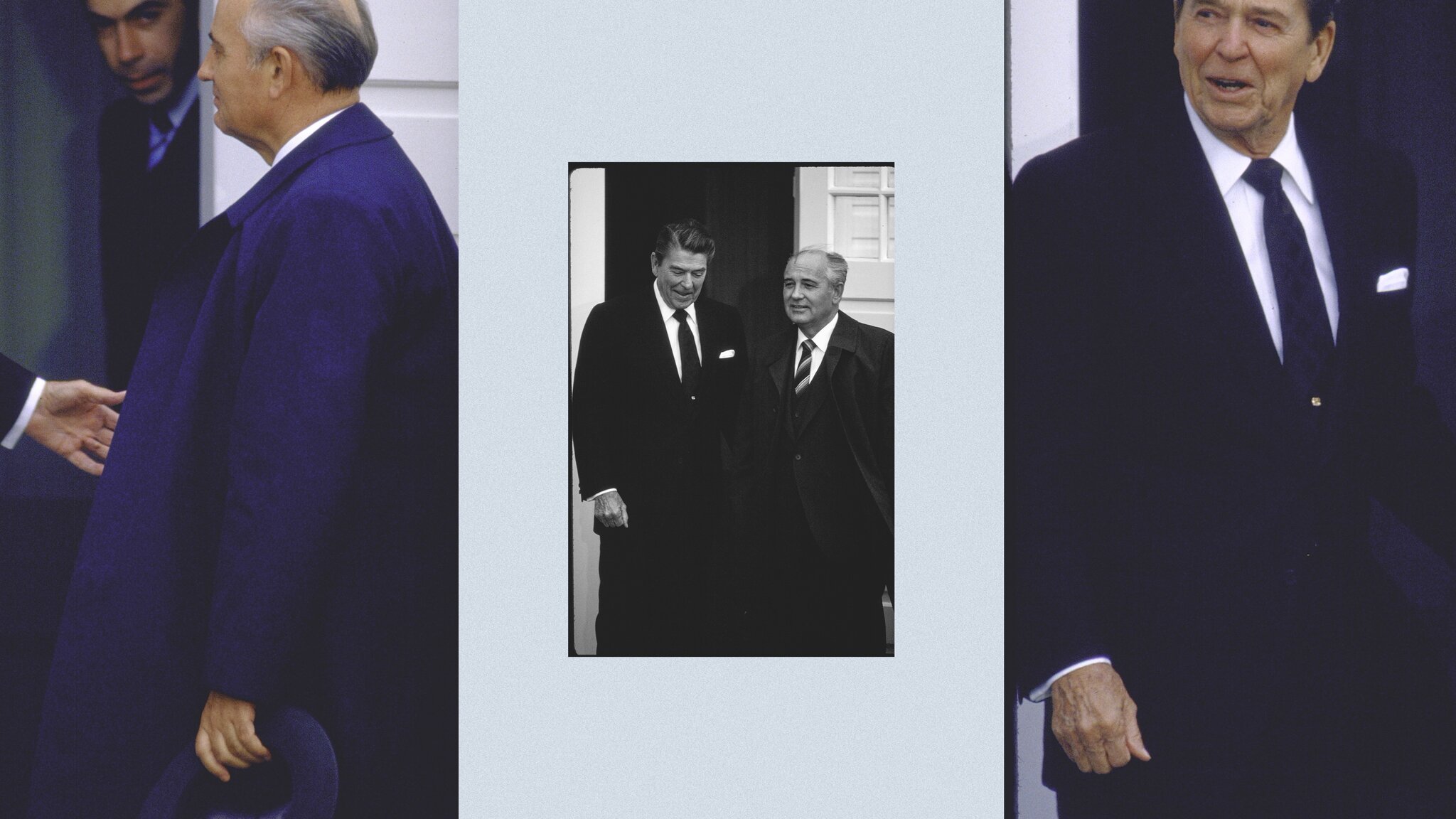
In October 1986, Reagan and Soviet General Secretary Mikhail Gorbachev met to discuss nuclear-arms control in Reykjavik, Iceland. At the time, I was a young scholar in Washington, training in Soviet affairs and international relations at Georgetown University and working at the Center for Strategic and International Studies. (I was also a two-time Reagan voter.) When the Reykjavik meeting took place, no one was looking ahead to the collapse of the Soviet Union; Kremlin watchers were, mostly, relieved to see a Soviet general secretary and an American president talking with each other.
The Brink of War , a new film released nationwide today, tries to bring texture and detail to those two days in Iceland. The movie relies on transcripts and other documents from the time, along with interviews with a former secretary of state, the late George Shultz (to whom the movie is dedicated). The film is a welcome corrective to the liberal orthodoxy about Reagan—specifically, that he was a disconnected simpleton who didn’t understand the complexities of the arms race. But it leans too much in the opposite direction: It is too kind to the Gipper, and takes too many liberties with the historical record.
As a viewing experience, The Brink of War is a better film than the only other movie about the summit, a 1987 British production titled Breakthrough at Reykjavik . But that’s because the earlier movie (now no longer available, as far as I can tell) was more accurate—and perhaps, for some viewers, more boring. The diplomats who met in the middle of the night thought they were ridding the world of nuclear arms, and that story has plenty of drama, but The Brink of War forgoes those details in favor of needless melodrama and a focus on fewer personalities.
[ Read: The thin line between biopic and propaganda ]
The title itself is misleading. The world was not on the brink of war in late 1986. Soviet-American tensions were much higher, and the risk of war much greater, during Reagan’s first term, which were perhaps the most dangerous years of the Cold War since the Cuban missile crisis. In the early ’80s, the Soviet Union was led by Yuri Andropov, a former KGB chief. In 1983 alone, Reagan gave his “Evil Empire” speech and announced the start of his missile-defense plan, the Strategic Defense Initiative; the Soviets shot down a civilian Korean airliner (killing a U.S. congressman); and the Americans overthrew a Marxist regime in Grenada. Andropov died in 1984, and Gorbachev took more than a year to gain power while the Kremlin stumbled along under the caretaker regime of the grievously ill Konstantin Chernenko.
Gorbachev’s arrival cooled some of these tensions. Almost a year before Reykjavik, Reagan and Gorbachev met in Geneva, where they issued a joint announcement that “a nuclear war cannot be won and must never be fought.” This was an important moment: Gorbachev, still consolidating power, was taking a risk by bucking anti-American hawks back in Moscow and standing with Reagan to join him in officially ruling out nuclear war as a rational instrument of policy.
By the time the two men met in Iceland, they were both determined to reduce their nations’ stockpiles of nuclear weapons. For Gorbachev, this reflected both a sincere belief and an economic imperative. The Soviet Union was struggling with the costs of boneheaded decisions such as the invasion of Afghanistan and the deployment of new and extremely threatening Soviet nuclear weapons in Europe. Reagan, despite his reputation among his critics as a warmonger, was actually an abolitionist when it came to nuclear weapons, and on this, he and Gorbachev were of one mind.
Both men had earlier made dramatic proposals to rid the world of nuclear arms. These were roundly dismissed in each other’s capitals as propaganda, but as it turned out, Reagan and Gorbachev were completely serious. The meeting foundered because of Reagan’s commitment to SDI, but the Reykjavik summit, despite its failure to reach any agreements, nevertheless suggested to the two leaders that they agreed about important things.
The Brink of War gets much of this right, but it portrays Reagan as highly prepared and Gorbachev as somewhat nervous. In reality, Reagan was concerned about the meeting, and at the start he relied on notes and cards he had in front of him. One of Gorbachev’s first observations when they met was about all the paper in front of his American counterpart; Reagan at one point dropped all of his notes and had to shuffle through them to get back on track. The film also shows Reagan confidently teasing his negotiating team about being Democrats, which was probably done so that the movie could make the summit seem like a bipartisan effort. It’s true that a few Reaganites were once Democrats, such as the negotiator Richard Perle, but this was not a team of liberals and conservatives. Perle was so distrustful of arms control with the Soviets that his nickname in Washington in the ’80s was the “Prince of Darkness.”
Soon the two leaders took up the proposal first discussed in Geneva for a 50 percent cut in Soviet- and American-weapons stockpiles. Reagan and Gorbachev, in the course of their discussion, agreed to eliminate all nuclear weapons, a move that surprised both delegations. The idea of full abolition—beloved b...