This is one outlet's own report from Gizmodo — the article as it was filed. Other outlets are covering the same event; open the full story to compare every source side by side.
This Plant Has Been Hiding a Killer Secret. Darwin Called It 150 Years Ago
It's been nearly 150 years since Charles Darwin's death. Yet, as research out today shows, scientists are still proving some of his educated hunches right.
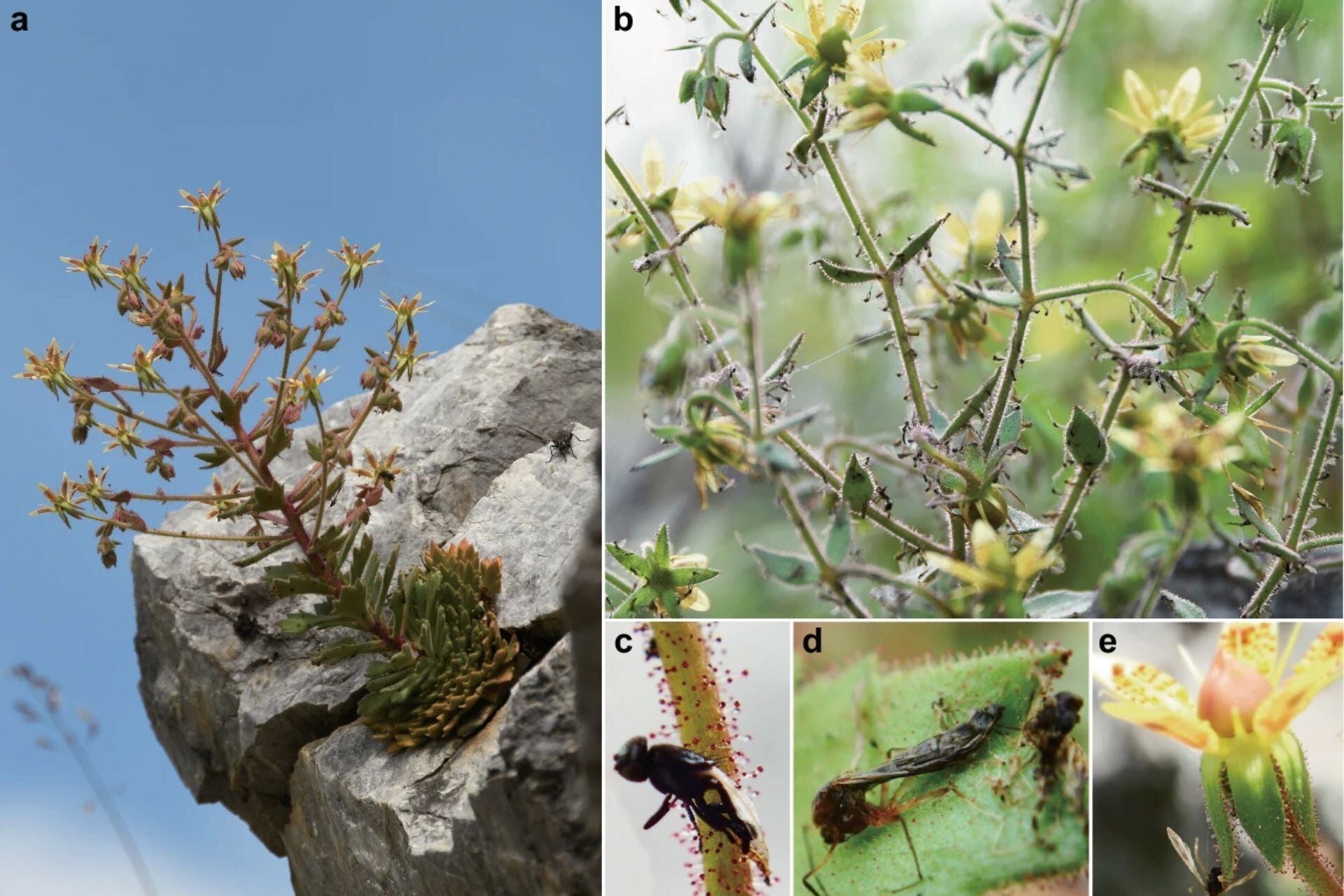
Researchers at the Florida Museum of Natural History and others seem to have discovered a new carnivorous plant—the same type of plant that Darwin once argued was carnivorous. The team's discovery should provide more insight into the evolution of these insect-eating oddities, the researchers say.
"This finding adds a new lineage to the pantheon of carnivorous plants," the researchers wrote in their paper, published Tuesday in the journal Nature Communications.
In 1875, Darwin published a book all about his experiments with carnivorous plants, titled Insectivorous Plants . In it, he made the case that at least two plant species in the genus Saxifraga were ravenous predators of insects. However, his feeding experiments at the time failed to conclusively demonstrate these plants were bona-fide carnivores, leaving the matter unresolved.
This latest study looked at a different species of Saxifraga ( Saxifraga candelabrum ), albeit one that shares an important bodily feature with the plants Darwin studied: specialized, glandular hair-like growths on the surface of the plant ostensibly used to trap hapless insects that wander too close. S. candelabrum is a herb native to the Hengduan Mountains in southwest China that cuts across the Tibetan Plateau and the Yunnan–Guizhou Plateau. Like many known carnivorous plants, it resides in soil environments that are lacking in nutrients, perhaps explaining why it evolved a hunger for insects to supplement its diet.
The study team, which included researchers from the Chinese Academy of Sciences, had tools not available in Darwin's day that helped them solve this mystery once and for all.
Their field experiments with fruit flies showed that S. candelabrum does indeed actively attract and capture insect prey via its glandular hairs. Further analysis found that the plant truly digests the insects it traps and that it absorbs nutrients from them, namely nitrogen. These traits—prey attraction, capture, digestion, and nutrition absorption—are the key criteria for confirming that a plant has the capacity for carnivorous behavior, also known as carnivory, according to the researchers.
"Our findings provide the first definitive evidence of carnivory in Saxifraga , addressing Charles Darwin’s long-standing hypothesis that some Saxifraga species may be capable of carnivory," they wrote.
The researchers' work not only validates Darwin, but it also deepens the questions surrounding carnivorous plants.
Studies have shown that carnivory evolved independently in different lineages or branches (pun intended) of plant life multiple times. The team's genetic analysis showed that similar mutations in certain genes have arisen across these different lineages, yet they also identified other genes that might be involved in carnivory.
And while S. candelabrum is the only known plant in Saxifraga to be carnivorous, there could be other species as well. Saxifraga plants are also only distantly related to other types of plant carnivores, such as Venus flytraps and pitcher plants. So its mere existence might suggest that "carnivory may be more widespread among [flowering plants] than previously recognized," the researchers wrote.
Whatever more lessons that are to be learned about carnivorous plants, it's nice to see that Darwin's influence on science is still alive and well.
AIPROPX is an independent multi-source news index — we track, compare, and connect coverage from across the web into one place you won't find anywhere else.