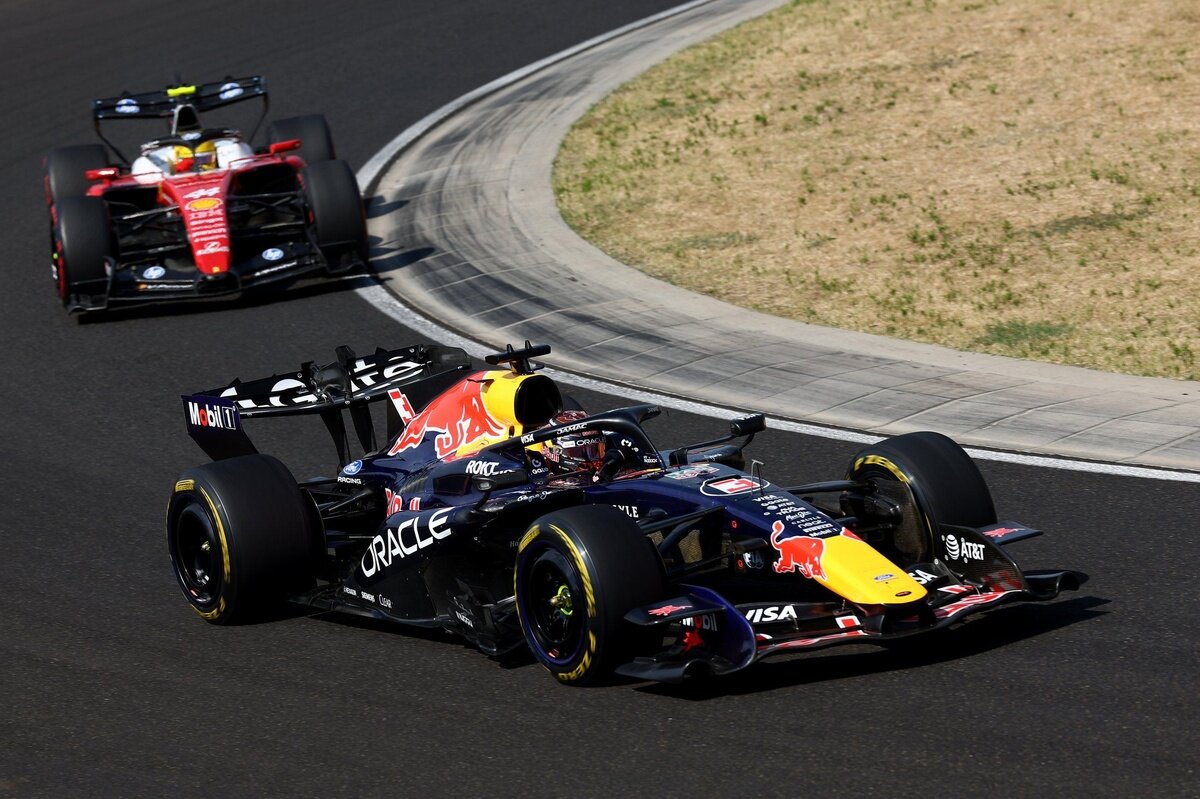
Motorsport photo
The FIA’s ADUO announcement – the Additional Development and Upgrade Opportunities for Formula 1 power units – had been a long time coming. In fact, after the results of the first period were shared with all teams and manufacturers at the Monaco Grand Prix, the press release was ready to go in exactly this form. The only thing missing was the sentence about the second period.
The long wait was due to Red Bull expressing considerable dissatisfaction with the outcome of the first period behind the scenes, with even Oliver Mintzlaff getting involved.
However, Red Bull had very few ways to challenge the result. The system undeniably has its weaknesses – more on those later – but the teams and manufacturers themselves agreed to it last year.
Red Bull Ford Powertrains could therefore only request a factual review, but that did not change the outcome either. FIA single-seater director Nikolas Tombazis said the governing body’s measurements had proved correct, despite Red Bull team principal Laurent Mekies arguing that there was "not a single data point" showing that Red Bull had the best engine.
Among other things, Red Bull pointed to its deficit at power-sensitive tracks. According to Mekies, that deficit was greater than at circuits such as Monaco and the Hungaroring, where the power units play a less significant role. In reality, that picture is also related to energy management at energy-starved tracks and how good – or not – a power unit is in that respect.
Those are factors the FIA does not take into account, as the ADUO ranking only measures the power output of the internal combustion engine. The FIA cannot publicly reveal too much about the exact measurement methods and data, not least because they involve intellectual property and confidential information.
"Due to the confidential nature of this information, no further details on power unit performance index measurements will be communicated," the FIA statement reads.
As a result, the press release merely states that Mercedes falls into the 2%-4% deficit category, which earns it one upgrade opportunity in 2026 and another in 2027. Ferrari, Audi and Honda all fall into the plus-4% deficit category, which gives them two new homologations – in the current season and two more next year.
The ADUO system was intended to help manufacturers lagging far behind, such as Honda, but has become a political battleground in F1
The ADUO system was intended to help manufacturers lagging far behind, such as Honda, but has become a political battleground in F1
In addition, all of these manufacturers receive extra financial headroom under the budget cap for power unit manufacturers. For Mercedes High Performance Powertrains, that means a cost cap allowance of up to $3m, while Ferrari receives up to $4.65m.
Notably, an additional safety net has been introduced specifically for manufacturers in serious trouble – such as Honda. A manufacturer more than 10% behind the best ICE would receive a cost cap allowance of up to $11m per ADUO period, plus an additional $8m for 2026 as a whole, but it was understood after the first period that Honda did not fully meet the criteria for that back then.
The Japanese manufacturer can nevertheless live with the outcome of the FIA’s analysis.
"I think the number we received from the FIA looks reasonable. I would say that number is fair. And also, thanks to ADUO, we are now working hard to develop our engine," chief engineer Shintaro Orihara told Motorsport.com.
FIA wanted to factor in championship standings – has Red Bull’s stance backfired?
The second period subsequently did not result in any additional tokens being handed out, indicating that the picture has not changed significantly.
For Red Bull, this could theoretically mean one of two things: either the newcomer is still right at the top of the ICE ranking, or its deficit is less than 2%. The latter scenario would not yield a token either.
However, Motorsport.com understands that the ranking and the gaps between the manufacturers remain broadly the same. This means Red Bull Ford Powertrains is indeed rated by the FIA as having the best internal combustion engine in F1.
Mercedes team principal Toto Wolff has acknowledged that the Silver Arrow has the best power unit, but as is well known, ADUO only looks at the internal combustion engine. This immediately highlights one of the system’s weaknesses: the measurement only concerns the ICE, but the upgrade opportunities consequently awarded go much further and also cover the electrical components.
Mercedes has the best power unit in F1, as Toto Wolff also acknowledged, but has nevertheless received a token
Mercedes has the best power unit in F1, as Toto Wolff also acknowledged, but has nevertheless received a token
Red Bull is still lacking on the electrical side, but because it has the most powerful ICE, it cannot do anything about that. And so the newcomer is effectively checkmated.
It is a weakness of the system, but the FIA cannot fully be blamed for it. Tombazis has told media that he was open to taking more parameters into account, but teams and manufacturers pushed to keep the system as simple as possible.
That includes the size of the turbo, an aspect Tombazis wanted to factor in. In practice, that did not happen, allowing Ferrari to benefit. The Italian manufacturer had an advantage off the line at the start of this year, thanks to its smaller turbo, but paid a price in terms of power. ADUO does, however, allow Ferrari to work on that, especially now that it has received two tokens.
It raises the question of whether that is fair given that these are deliberate design choices, but that is simply how the system works.
Moreover, the FIA intended to take the championship standings into account. After all, ADUO was not designed to give the dominant force even more upgrade opportunit...